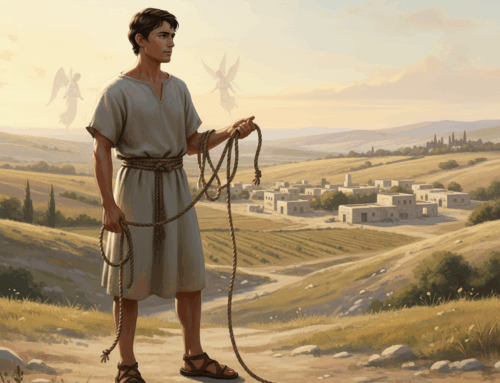

Zechariah 1:18-21
18 And I lifted my eyes and saw, and behold, four horns! 19 And I said to the angel who talked with me, “What are these?” And he said to me, “These are the horns that have scattered Judah, Israel, and Jerusalem.” 20 Then the Lord showed me four craftsmen. 21 And I said, “What are these coming to do?” He said, “These are the horns that scattered Judah, so that no one raised his head. And these have come to terrify them, to cast down the horns of the nations who lifted up their horns against the land of Judah to scatter it.” [1]
As we heard in verse 7, and we noted last week, this is the second time that the word of the Lord has come to the prophet Zechariah. This revelation occurs in 520 BC, the same year as his first revelation. His first word from God was quite plain. We could sum it up in one word: repent. But this revelation from God is in a quite different format. As we have noted in the last two weeks, this style of literature is called apocalyptic literature. Another way this second revelation is different from the first is that this revelation extends from verse 7 all the way through to chapter 6. It is one long vision with quite different scenes that all form one long tapestry.
As his angel guide interprets these visions, he points out all these scenes that string together as these panels come alive with action. Notice this whole section is punctuated with Zechariah recounting how he looked at something, or how he looked up and saw something. His angel guide functions like a docent in the museum. He is the heavenly expert who points out the imported details we might otherwise miss. He is the divine art expert who understands the language of this tapestry.
We are dealing with symbols and types when we deal with apocalyptic literature, images that draw us in emotionally and prompt us to consider how these images relate to other pictures and events in scripture. What do they reveal about God’s great plan for his people? God wants us to grow mentally and emotionally. Apocalyptic images, like all art, intend to provoke thought and emotion.
In Zechariah’s first vision the messianic angel appeared as a warrior mounted on a red warhorse, present in the midst of God’s people reflecting the glory of God’s promises (the myrtles). Under his command stood a squadron of supernatural agents (the flame-colored horses), ready to execute the judgment which the Lord threatened against the evil world-empire (the deep), usurper of dominion over mount Zion. Here was a predisclosure that when Christ was manifested, it would be to “destroy the works of the devil” (1 John 3:8), to cast Satan down from heaven to hell (Luke 10:18; Rev 12:10; 20:10), and so fulfill the primeval decree that God’s champion should crush the draconic head lifted up against the holy mount in Eden (Gen 3:15).[2]
This theme of the ultimate divine avenging of Zion against her enemies is taken up again in Zechariah’s second vision (1:18–21). The hostile nations are symbolized here by four horns and the inflictors of divine judgment by four specialist workmen, a kind of specialized deconstruction team.
ZION’S BULLIES
The interpreting Angel describes the horned nations as having lifted up the horn against Judah, Israel, and Jerusalem, scattering them so that they could no longer lift up their heads (1:18, 21). This would have been common imagery in agrarian societies. If you’ve ever observed wildlife or domesticated livestock, you may have seen this interaction. I once watched a large axis buck approach my deer feeder while several smaller white-tailed doe were nibbling away. Then he walked in, stomped its hooves, and swung his massive rack of horns. Those little white-tailed doe scattered and could only nibble away nervously at the margins of the feeding area.
The language used here is in the prophetic idiom. The prophets employed the typological situation of their time to represent the ultimate realities of the coming messianic age. In this case, the typological situation is Israel’s current oppression by her enemies, her bullies. God promises Jerusalem an immediate solution to their problems. God will design and grow Jerusalem again. But he also promises a final solution to the problems of the entire world. He will vanquish evil, reunite heaven, and earth, and live with his people again.
The offense of the horned nations was twofold: putting down God’s chosen people and exalting themselves against the Lord God. To use the apostle John’s language from revelations, they made war against the Saints, and they blasphemed the name of God (Revelation 13:6, 7). So we will look at those two dimensions of the world’s assault on God’s people.
ENMITY
The number of horns is not significant to the image. This is simply an image of animals with horns. Verse 21 shows an image like that of an attacking bull, lowering its head then thrusting its lethal horns upward. The Old Testament equates horns with imperial powers hostile to Israel and the metaphor of monstrous beasts, like the multi headed leviathan, is often applied to such nations in scripture (Ps 74:13, 14; Isa 27:1; Ezek. 29:3).
An examination of Daniel chapters 7 and 8 confirms the primary animal nature of the image of four horns. In Daniel 7 and 8 the horns of various animals figure conspicuously in the depiction of empires ascendant over the realm covenanted to David. Medo-Persia is symbolized in Daniel 8 by a ram with two horns and Greece by a goat, which begins as a unicorn, then has four horns, one of which sprouts the little horn whose career of antagonism against Zion is an Old Testament type of the final antichrist episode. Daniel 7 presents a series of four bizarre beasts, the last of which, the terrible destroyer whose career terminates in the final judgment, has ten horns plus an eleventh, the little horn that symbolizes the antichrist spirit and program throughout church history. Marking the connection between Zechariah’s horn-nations and the nations represented by the horned animals in Daniel 7 is their common place of origin. It is from the great stormy deep that the four beasts of Daniel 7 emerge (vv. 2, 3). And if we appreciate the relationship of the second vision to the first within the unity of Zechariah’s opening triad, we will recognize that the spawning place of the four horn-nations of vision two is the deep, which symbolizes the hostile world in vision one.[3]
The animal motif extends to the picturing of God’s people, the victims of the horns’ attack, as a flock, a favorite image later in Zechariah (cf. 9:16; 10:2, 3; 11:3–17; 13:7). The verb denoting the dispersing of Judah (vv. 19, 21), is used for the scattering of sheep (cf. Ps 44:11; Jer 31:10). The theme of the dispersed flock is found in Zech 10:1–4, the section of the book that corresponds to the second vision on the first side. Moreover, the afflicters of the flock are also animals, goats (10:3), and once again, as in vision two, the Lord in his anger against the animal-powers provides deliverance for his flock (10:3, 4).
By itself, the image of the horn symbolizes the exertion of power and the achievement of success or attainment of glory. Cutting off and throwing down a horn symbolizes defeat and impotence. An accompanying image is that of lifting up a head full of horns, with its opposite being unable to lift up its head. Combining the two forms of the metaphor, Zechariah introduces into the meaning of lifting up the horns the specific connotation of ferocity, hostility, and tyranny by depicting the action as an animal like attack against Judah that devastated it and rendered it helpless. This was the offense of the horned nations because their exaltation involved a malicious trampling of the covenant people into the ground. Coming up from the dark deep at the devil’s instigation, the beast-like horned nations showed satanic enmity against the Saints.
BLASPHEMY
The horn is an image a persecution directed against God’s people. But to attack God’s people is also to defy the heavenly protector to whom Judah cried, “how long”? To March against Zion is to storm the very mountain stronghold where the holy God is enthroned. The act becomes one of blasphemy against the God of Zion, a lifting up and shaking of the horns in challenge to the most high. It becomes a Har Magedon (God’s mountain) event.
Psalm 74 emphasizes this blasphemous dimension of attacking the Lord’s heritage. The situation is much like that in Zechariah’s vision. God’s people, pictured as his flock (vv. 1, 2), appeal to him, the one who broke the heads of the leviathan monster (vv. 13, 14), to raise them from the ruins wrought by their adversaries (v. 3), who are referred to as animals (vv. 4, 19). They lament that the foes “burned your sanctuary to the ground; they defiled the dwelling place of your Name” (v. 7) and they plead, “How long will the enemy mock you, O God?” (v. 10). “Rise up O God and defend your cause” (v. 22). And in Psalm 75 such defiance of the God of heaven is described by the horn metaphor: “To the arrogant I say, ‘Boast no more,’ and to the wicked, ‘Do not lift up your horns. Do not lift your horns against heaven’” (vv. 4, 5a).
We see animal horn symbolism in the Psalms and in Daniel and in Revelation. The little horn of the goat in Daniel 8 (representing Antiochus Epiphanies) magnifies himself to the hosts of heaven, even to the Prince of the host (Daniel 8:10, 11, 24, 25). And the little horn of the 4th beast in Daniel 7 has facial features, eyes, and mouth as a kind of combined horn-head, and it spoke defiant words against the most high (Daniel 7: 8, 20, 25).
Now that we have some idea of how horns can be used in apocalyptic literature, it gives us a foundation for why horns are used as architectural features, such as horns placed on the corners of an altar or on the tops of ziggurats. It might sound to you like Zechariah is simply seeing disembodied horns. In fact, these are horns on a pagan altar and God has sent craftsman to saw them off. In our text the horns no longer rise from the heads of beasts but project upwards from the corners of a 4-horned altar (Ex. 27:2; 30:1). But this altar is not the great 4 horned altar of the Jerusalem temple, this altar reflects the religion of the world, the flesh, and the devil. The image is one of God’s stripping power away from worldly religious and political systems.
Exploring the symbolism of lifting up the horns leads us down a fascinating trail of altars, idols, ziggurats, and mountains. Our first steps down that trail begin with the roots of Zechariah’s vision in the book of Daniel, focusing on the vision of the world kingdom in the form of the great colossus in Daniel chapter 2. In that vision, a great golden head is lifted up upon the top of a great statue representing Nebuchadnezzar and his Babylon in the land of Shinar (Daniel 2: 37, 38).
Actually read through Daniel, continue to see Nebuchadnezzar exalting himself against God. In chapter 1:2, he carries off the captives and temple treasure off to Babylon. He takes God’s treasure and places it in the treasure house of his own false idle. Chapter 3 tells of him building his gigantic golden idol and, in powerful beast-like fashion, he commands that it be worshipped. Chapter 4 portrays the king as a cosmic tree with his top reaching heaven (4:11, 20). Chapter 5 narrates the judgment on Belshazzar for raising himself up against the Lord and promoting the praise of idols in (5:23).
All the instances of rebellious pride we see in the book of Daniel were merely a revival of the lifting up of the horns that occurred at Babylon’s beginning in the land of Shinar (Genesis 11:1-9; Zech 5:11). Humanity was still collectively aware that it had lost Har Magedon, God’s mountain/temple in the land of Eden. It was the cultic focus of God’s garden-kingdom. The ancient Babylonians tried to regain humanity’s loss of collective religion enjoyed in the Garden of Eden by building their own cosmic mountain in the form of a tower. We can see something of their ideology when we read the epic Mesopotamian mythology known as the Enuma Elish.
The Enuma Elish epic attributes the origins of Babylon to the gods at the founding of the world order. In honor of Marduk, their champion, they constructed his temple with its tiered tower, named Esagila. That name is of special interest to our present investigations for it means “the house of the lifting up of the head.” Punning on that name, the text says that after a year of making the bricks for it (cf. Gen 11:3) “they raised the head of Esagila on high” (Enuma Elish, VI, 62). Also of particular interest for our immediate purposes, the text notes that once Marduk was enthroned there, “they looked up to its horns” (Enuma Elish, VI, 66). The temple tower was crowned with horns. Similarly, ziggurats as later depicted in inscription and bas-relief have horns on the summit. Symbolized by such a crown of horns was the divine power and glory of the resident deities. Elsewhere in iconographic representations of gods they appear with headpieces composed of paired horns, some with four or more horns. One wonders whether such multitiered crowns tapering toward the top imitate ziggurat form. Certainly, like the horns on the ziggurat, they symbolize divine might and majesty, the ultimate lifting up of the head.
Individual ziggurats had names that identified them more specifically as the cosmic mountain, the axis or access between earth and heaven: house of the mountain, house of the mountain of the universe, house of the link between heaven and earth, and (so the ziggurat at Babylon) house of the foundation of heaven and earth. Ziggurats were then gigantic models of a terraced mountain, the mountain of the gods. By their tiered form with staircase ascents they were intended to serve as a way of ascent and descent between earth and heaven for men and deities. To aspire to fellowship with the living God, to seek access to him in worship and communion, is to appreciate the complete goodness of human existence.
In the beginning the Creator provided for such sacramental divine presence and human approach in the mountain of God in Eden and after the Fall he restores this redemptively (cf. Jacob’s staircase to heaven, Sinai, and Zion). But the Babel-tower tradition did not express a longing of the soul for the living and true God and his heaven. It was rather a rebellious attempt of fallen mankind, rejecting God’s redemptive offer of restoration, to regain heaven by human works. As a substitute for true religion it was an idolatrous venture, an antichrist affront to the true Har Magedon. It was from Nimrod to Nebuchadnezzar a lifting up of the head-horns against the Lord God.[4]
There are strong points of correspondence between the altar and the temple-tower or ziggurat-mountain phenomenon that looms so large in this Daniel-Babel tradition drawn on by Zechariah.
Most obvious is the fact that the altar in Israel’s cult and the ziggurats are alike in being capped by four horns, bronze in each case, which are symbolic of divine power. This correspondence has prompted the view of the ziggurats as colossal altars.[5]
Second, there is evidence that the altar form was a stylized stepped mountain. So, in Ezekiel’s prophetic description of the ultimate restoration of the temple on the top of the mountain, the altar is depicted as a tiered structure, the topmost stage having four horn projections (43:13–17). Besides this ziggurat shape of the altar, certain terms in Ezekiel’s description are evocative of the mountainous nature of ziggurats; namely, “the bosom of the earth” (with reference to the bottom of the altar) and “mountain of God” (with particular reference to the top with its four horns).
This mountain motif can be seen in Zechariah’s vision. Zechariah employs the image of a mountain for that imperial opposition to the restoration of God’s temple (4:7; 6:2). He identifies it further in Genesis 11 terms with the land of Shinar (5:11).
Zechariah’s references to Daniel and the story of Babel are clear. It confirms the reference of this symbol of four horns are horns of an altar, in this case an altar erected by pagan powers. Illuminated by the Old Testament background, Zechariah’s symbolism captures that ideological essence of the great beast-kingdom and it’s Antichrist. They display self-deifying defiance of the Lord’s Anointed who reigns on the true Har Magedon. It was a lifting up of horned heads in enmity against God’s people and in blasphemous idolatry against God himself.
As I studied this text this week I was so excited to see all those images in the Old Testament that lurk in the background of these few verses. Strangely, I was kind of geeked out over the biblical theology but not at all bothered by the image of evil oppressing God’s people. I mean we all know that happens right? The world the flesh and the devil are always raising their horns. So I finished up most of my research on Wednesday afternoon, excited to tell you what I thought was some cool stuff about evil. And then I turned on the news.
Suddenly, there was nothing academic about evil. It had real consequences, and it destroyed the life of a man trying to tell people about Jesus. This prophecy from Zechariah was given to God’s people in the midst of this very type of violent oppression. And to the people of Zechariah’s time, as well as to us in our time, God has sent the Man among the myrtles who watches over the deep. No horned creature escapes his opposition. The Angel of the Lord will send his craftsmen to cut off the horns fully, finally, completely, and eternally.
So, let me leave you with a better image than the ones you have received from news and social media this week. It is one of the great and final images of the apocalypse:
9 Then came one of the seven angels who had the seven bowls full of the seven last plagues and spoke to me, saying, “Come, I will show you the Bride, the wife of the Lamb.” 10 And he carried me away in the Spirit to a great, high mountain, and showed me the holy city Jerusalem coming down out of heaven from God, 11 having the glory of God, its radiance like a most rare jewel, like a jasper, clear as crystal. 12 It had a great, high wall, with twelve gates, and at the gates twelve angels, and on the gates the names of the twelve tribes of the sons of Israel were inscribed— 13 on the east three gates, on the north three gates, on the south three gates, and on the west three gates. 14 And the wall of the city had twelve foundations, and on them were the twelve names of the twelve apostles of the Lamb.
15 And the one who spoke with me had a measuring rod of gold to measure the city and its gates and walls. 16 The city lies foursquare, its length the same as its width. And he measured the city with his rod, 12,000 stadia. Its length and width and height are equal. 17 He also measured its wall, 144 cubits by human measurement, which is also an angel’s measurement. 18 The wall was built of jasper, while the city was pure gold, like clear glass. 19 The foundations of the wall of the city were adorned with every kind of jewel. The first was jasper, the second sapphire, the third agate, the fourth emerald, 20 the fifth onyx, the sixth carnelian, the seventh chrysolite, the eighth beryl, the ninth topaz, the tenth chrysoprase, the eleventh jacinth, the twelfth amethyst. 21 And the twelve gates were twelve pearls, each of the gates made of a single pearl, and the street of the city was pure gold, like transparent glass.
22 And I saw no temple in the city, for its temple is the Lord God the Almighty and the Lamb. 23 And the city has no need of sun or moon to shine on it, for the glory of God gives it light, and its lamp is the Lamb. 24 By its light will the nations walk, and the kings of the earth will bring their glory into it, 25 and its gates will never be shut by day—and there will be no night there. 26 They will bring into it the glory and the honor of the nations. 27 But nothing unclean will ever enter it, nor anyone who does what is detestable or false, but only those who are written in the Lamb’s book of life.
22 Then the angel showed me the river of the water of life, bright as crystal, flowing from the throne of God and of the Lamb 2 through the middle of the street of the city; also, on either side of the river, the tree of life with its twelve kinds of fruit, yielding its fruit each month. The leaves of the tree were for the healing of the nations. 3 No longer will there be anything accursed, but the throne of God and of the Lamb will be in it, and his servants will worship him. 4 They will see his face, and his name will be on their foreheads. 5 And night will be no more. They will need no light of lamp or sun, for the Lord God will be their light, and they will reign forever and ever. [6]
[1] The Holy Bible: English Standard Version (Wheaton, IL: Crossway Bibles, 2016), Zec 1:18–21.
[2] Meredith G. Kline, Glory in Our Midst: A Biblical-Theological Reading of Zechariah’s Night Visions (Eugene, OR: Wipf and Stock Publishers, 2001), 57.
[3] Meredith G. Kline, Glory in Our Midst: A Biblical-Theological Reading of Zechariah’s Night Visions (Eugene, OR: Wipf and Stock Publishers, 2001), 58.
[4] Meredith G. Kline, Glory in Our Midst: A Biblical-Theological Reading of Zechariah’s Night Visions (Eugene, OR: Wipf and Stock Publishers, 2001), 61–62.
[5] Meredith G. Kline, Glory in Our Midst: A Biblical-Theological Reading of Zechariah’s Night Visions (Eugene, OR: Wipf and Stock Publishers, 2001), 62.
[6] The Holy Bible: English Standard Version (Wheaton, IL: Crossway Bibles, 2016), Re 21:9–22:5.