
Zecharia 3
1 Then he showed me Joshua the high priest standing before the angel of the Lord, and Satan standing at his right hand to accuse him. 2 And the Lord said to Satan, “The Lord rebuke you, O Satan! The Lord who has chosen Jerusalem rebuke you! Is not this a brand plucked from the fire?” 3 Now Joshua was standing before the angel, clothed with filthy garments. 4 And the angel said to those who were standing before him, “Remove the filthy garments from him.” And to him he said, “Behold, I have taken your iniquity away from you, and I will clothe you with pure vestments.” 5 And I said, “Let them put a clean turban on his head.” So they put a clean turban on his head and clothed him with garments. And the angel of the Lord was standing by.
6 And the angel of the Lord solemnly assured Joshua, 7 “Thus says the Lord of hosts: If you will walk in my ways and keep my charge, then you shall rule my house and have charge of my courts, and I will give you the right of access among those who are standing here. 8 Hear now, O Joshua the high priest, you and your friends who sit before you, for they are men who are a sign: behold, I will bring my servant the Branch. 9 For behold, on the stone that I have set before Joshua, on a single stone with seven eyes, I will engrave its inscription, declares the Lord of hosts, and I will remove the iniquity of this land in a single day. 10 In that day, declares the Lord of hosts, every one of you will invite his neighbor to come under his vine and under his fig tree.” [1]
A remnant of Jewish people has returned from Babylon to their homeland of Judah after 70 years of exile. They have spent the last 20 years rebuilding their homes, plying their trades, and earning comfortable livings. They have put their resources into redecorating and enlarging their houses. But God’s temple is still in ruins. And now, their crops are beginning to fail. It has been a poor harvest year.
Now that God has gained the people’s attention by hitting them in the pocketbook and the belly, he sends two prophets to the people of Judah. He sends a long-retired priest by the name of Haggai to speak cleanly and clearly to the people, urging them to return to the Lord and complete his temple. The Lord also sends a younger priest by the name of Zechariah. This young priest is given an entirely different form of communication: apocalyptic visions. Technically, he has one long vision in which he views a tapestry with many different panels or scenes.
In the first scene of this tapestry Zechariah saw an Angel riding a red war horse, standing among the glorious myrtles and watching protectively over the evil deep from which crawl the horned beasts that oppose God’s people and God. The man among the myrtles is addressed both as the Angel of the Lord and as God. He is the one who protects and pleads for his people.
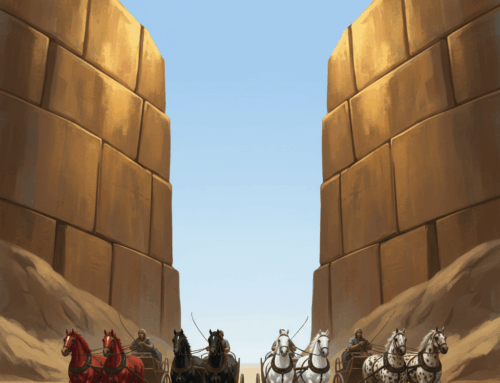
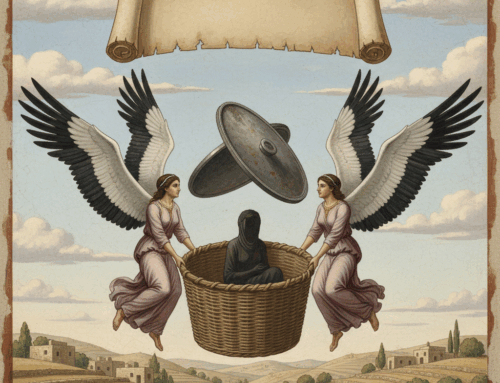
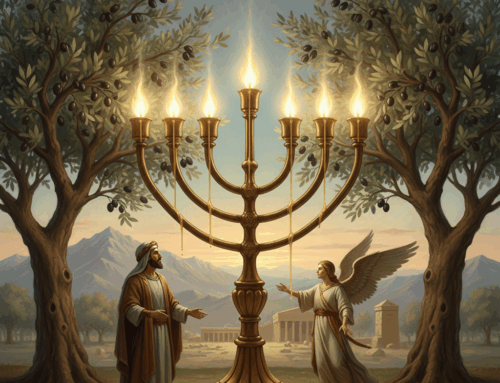
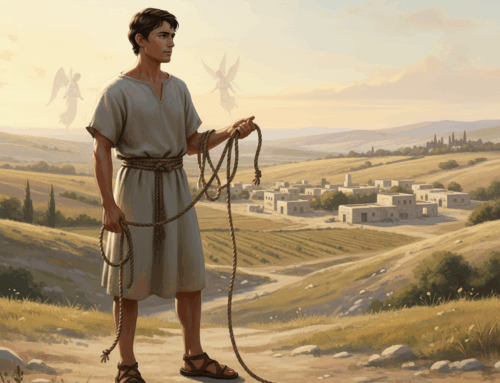
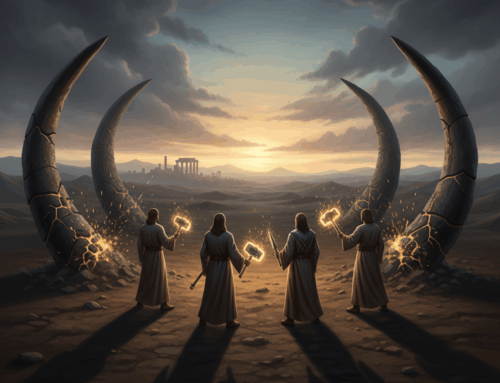
In the second panel of this tapestry, Zechariah saw four horns. In the Old Testament, horns were symbols of power. God’s sacrificial altar was crowned with four horns, one on each corner. What the young prophet sees is a pagan copy of God’s sacrificial altar. But Zechariah sees four carpenters sent by the Angel of the Lord to deconstruct the pagan altar and lift the oppression upon god’s people. In the third panel of this vision, the prophet sees the Angel of the Lord with the ruler in his hand and receives the encouraging promise of a new Jerusalem that not only outstrips his present reality, but also far outstrips anything anyone could imagine. This is the heavenly Jerusalem come down to earth (described also in Revelation 21), God and his people fully and finally and eternally joined in perfect fellowship.
This fourth scene of our tapestry is the most important of the night visions because it’s found right in the middle. And as you may recall, in Old Testament prophecy, the most important stuff comes in the middle. Unlike the previous panels in the tapestry, this image it’s strikingly familiar to the young priest. In the previous panel he took a kind of prophetic flyover of the new Jerusalem. Now he is drawn into the heart of that city, into God’s heavenly temple-throne room where a trial is taking place.
THE CHARGE
Zechariah recognizes a familiar figure, his boss the high priest Joshua. Perhaps when he was born in Babylon his faithful Jewish parents named him Joshua in hopes that he too would deliver his people. Zechariah sees him clothed in all of his fine, jeweled, vestments of the priesthood. He wore a breastplate with 12 precious stones and shoulder pads with the names of 6 tribes engraved on each pad. It meant that as the high priest ministered before God, he carried all of Israel on his heart and on his shoulders. He represented his people before God.
The tapestry begins to move, and Zechariah hears voices. And as he looks around he realizes he is not in an earthly temple at all but has been drawn into this tapestry of God’s heavenly courtroom. And before him he can see not only the high priest, but the Angel of the Lord and YHWH seated on his throne. This particular scene, the central theme of the night visions, is like a play that unfolds in three acts. And the first act is the charge, the accusation, made against Joshua as the representative of all Israel.
Joshua is seen standing between the Angel of the Lord and the prosecutor. That word “to stand” was used particularly of priests to describe their duty. They stood before the presence of the Lord as they ministered to the people. This is servant language. The servant would stand before his master waiting to do the master’s bidding. Just as Zechariah, recognizes Joshua he hears another more sinister voice. He recognizes Satan, the great accuser, who is bringing charges against Joshua the high priest.
This is the same scene we read about in the 1st chapter of Job. God is present and his angelic servants stand before him in heavenly council. In both cases, Satan has shown up to accuse one of God’s servants. His only motivation is to tarnish God’s glory by tarnishing the reputation of God’s people. That is his mission as we find him throughout the scriptures. Here he accuses the high priest of being dressed in filthy garments, excrement-smeared vestments. In other words he accuses the high priest of faithlessness, moral unworthiness, covenant breaking. By accusing the high priest, he is accusing all of God’s people. He is stating that the high priest is not fit to be in God’s presence while tainted with sin.
And that is Israel’s problem. Satan’s charge is absolutely true. The high priest is smeared with excrement because he and his people have constantly and repeatedly broken God’s covenant. In fact, that is the very reason for the remnant in the land. Despite their sin, God has allowed them to return, and the devil is arguing that they have no place before God and should have no place in his New Jerusalem. They deserve no place in the presence of God, much less to dwell in his new Jerusalem. We are sinful creatures who deserve no place near the presence of God.
JOSUA’S DELIVERANCE (2-7)
That is the first act of our drama. Through its high priest, Satan has made a true and accurate charge that Israel has no place in God’s presence because of its sin. Fortunately for us, there is a second act in this drama. It’s verse one describes an accurate charge of the people’s sinfulness, verses 2 through 7 describe their deliverance.
Deliverance comes through the Angel of the Lord. He is a separate character from YHWH. He both speaks to and speaks as God. The Angel of the Lord is a clue in the Old Testament that God’s personality is diverse. He is the one closed in the glory of myrtles standing watch over the chaotic and evil deep. He is the one who sends the carpenters to saw off the arrogance of the pagans. He is the eternal being with the measuring rod who plats out the greatness of the new Jerusalem. Now he is the one standing in front of the eternal bench advocating for Joshua. He is the one who would come as a Carpenter to destroy the works of the devil, not by means of woodworking but by means of being nailed to a cross.
I don’t think we have to wonder how Joshua felt listening to the accusations of the evil one. Each and every one of us have a sense that we are guilty before a holy God. Like the horns on the Pagan altar, Joshua’s head has been forced down into shame. He stands stinking and covered in excrement before God as he listens to an accusation he knows is true. He felt like many of us feel when the enemy is harassing us. Church was likely the very last place Joshua wanted to be in that moment. When you hear that dark voice, know that it is merely an echo of this very scene taking place in heaven’s eternal courtroom.
John writes in Revelation chapter 12 that the Saints overcame the evil one by the blood of the Lamb and by the word of their testimony. If you are trusting into the blood shedding death of the gloriously resurrected and ascended lamb, the Angel of the Lord, the Lord Jesus Christ then you can quietly agree with Satan that you are worthless and that you don’t deserve to be in the House of the Lord. But far greater than that is the fact that you have been washed white by the blood of the Lamb!
The lamb answers the charge in just 4 words: “YHWH rebuke you, Satan.” And you will notice from this moment on the prosecutor is totally silent. It is a word of divine judgment just like the words spoken against the great dragon-serpent in Genesis 3. Following that rebuke he speaks words of tenderness for his people. God points out that he himself had chosen this people and that Joshua was like a smoldering stick rescued from the fire. God rebukes the devil and defends his people all out of his own passionate, free electing love. Despite our sin and rebellion against him God has chosen us based upon no merit of our own but solely upon his own free will.
For generations before Zechariah’s time, The nations laughed and mocked at God’s people. He must certainly be dead. His people were all captured and enslaved. This little band of Jews back in is poor and weak and clearly has no God at all. Even his own people must believe him to be dead because they haven’t bothered to build his temple. Joshua should have been urging his people to rebuild the temple. He should have been overseeing the construction of the walls. He was a disastrous failure as a high priest. But God loved him anyway, simply because God chose to do so.
God first speaks a word of rebuke to Satan and now speaks a word of remission over Joshua and Israel. God remits Israel’s sin. He exchanges their sin for his righteous dress. God even specifically says that he is taking away their sin and exchanging it for rich garments. Joshua himself does not suddenly become better. He is the beneficiary of a great exchange: the filth of his sin for glorious new high priestly garments complete with a new crown. The Angel of the Lord has displayed his authority to take away sin.
You may recall Isaiah had a similar vision in Isaiah 6 when he entered the earthly temple in Jerusalem and found out he was standing in the middle of God’s heavenly court. And he sees these majestic heavenly creatures repeatedly screaming out the overwhelming presence of God’s holiness. Isaiah’s reaction was to pronounce a prophetic curse upon himself because he was a man of unclean lips who lived among people with unclean lips. An angel takes a coal from the altar and puts it to Isaiah’s lips and then pronounces him sinless and guiltless.
In both of these passages a great exchange takes place. The language of acquittal is similar in both passages. But in Zechariah it is the Angel of the Lord who accomplishes and announces the great exchange. The Angel of the Lord not only announces the removal of his people’s sins, he promises to put rich garments upon us. Joshua is not getting a do over, he is getting a complete makeover. The Angel of the Lord speaks a word of restoration to this fallen son of Adam, for whose sins the Last Adam will pay. There is a word of rebuke. There is a word of remission. And finally there is a word of restoration in vv. 2-7.
Zechariah is so amazed and excited that he can’t keep silent and he cries out for the turban to be placed on the high priest’s head. And the angels respond by doing as he asked (3:5) as the Angel of the Lord stands watching over the great exchange. 6 And the angel of the Lord solemnly assured Joshua, 7 “Thus says the Lord of hosts: If you will walk in my ways and keep my charge, then you shall rule my house and have charge of my courts, and I will give you the right of access among those who are standing here. He recommissioned Joshua to a life of personal holiness and faithfulness to God’s word. And he promised him a place in the heavenly court of the new Jerusalem.
This picture reminds us of Christ’s parable of the prodigal son. The son returns low and beggarly, but the father runs out to embrace him and throws a cloak of inheritance around his son. The father has great joy and great pride in that smoldering stick plucked from a fire. The son is not only restored to his position of sonship which he had lost but also is invited into the great joy which he had never truly known. Had he known the joy of sonship he never would have left home. But now out of his lowly state he has received not only the cloak of inheritance but also the peace of resting in the father’s love.
If you are trusting into Christ this morning it is impossible for me to imagine that you cannot see this glaring picture of the person and work of the Lord Jesus Christ so intricately woven into this tapestry. 1st we saw Joshua’s dilemma in verse one. Then we saw his deliverance in vv.2-7. Now in vv.8-10 the Angel of the Lord speaks about Joshua’s significance.
SIGNIFICANCE (8-10)
Joshua the high priest and his subject Zechariah the priest become men symbolic of God’s new great plan. 8 Hear now, O Joshua the high priest, you and your friends who sit before you, for they are men who are a sign: behold, I will bring my servant the Branch. 9 For behold, on the stone that I have set before Joshua, on a single stone with seven eyes, I will engrave its inscription, declares the Lord of hosts, and I will remove the iniquity of this land in a single day. 10 In that day, declares the Lord of hosts, every one of you will invite his neighbor to come under his vine and under his fig tree.
God describes two things about this sign he is bringing. He’s bringing someone who is a servant. Second, he is described as the Branch. You can tell that Zechariah has read the earlier prophets Isaiah (4:2) and Jeremiah (23:5, 6) who both mention the One to Come as the Branch. Martin Luther sums up these few verses this way:
Beautifully he connects …those two priesthoods—the legal one and that true one of the great High Priest, Christ. In substance he is saying: “High Priest Joshua, listen to what I intend with that external priesthood of yours. I am renewing the promises about the coming Christ. For the manifold promises of the Law have this point, that Christ will be a priest. So go ahead! Take charge of that external priesthood until He comes. For it is on His account that both the people and the priesthood had to be restored, that the promises might come true.”[2]
He is also called a stone in Ps. 118:22: “The Stone which the builders rejected”; and in Is. 8:14: “a Stone of Offense and a Rock of Stumbling to both houses of Israel”; and again in Is. 28:16: “Behold, I am laying in Zion for a foundation … a Cornerstone.” Christ is called Stone because all of us who are Christians lean upon Him. He alone is our firm foundation on whom we can rely. Paul also interprets Christ this way (cf. 1 Cor. 3:11).
There are seven facets. This is what Isaiah says: “The Spirit of the Lord is upon Me because the Lord has anointed Me” (Is. 61:1). The seven facets, then, are the seven spirits or gifts of the Holy Spirit which Christ has distributed in the church. These gifts cause that Branch to blossom forth, even though the world, Satan, and all creatures always stand against it.[3]
And I will remove the guilt of this land In a single day. On the day of His suffering He bore all our sins, as Isaiah writes (cf. Is. 53:4): “He Himself carried our sins.” You see, through and in the crucified Christ, God took away the sin of the whole world. In this way the prophet indicates that true Priest finally will come to take away the sin of His people and to free them from their sins. This finally will be the true sacrifice, of which the priesthood of Joshua, the high priest of the Law, was incapable. He further declares that this will happen in a single day. With this one phrase he annuls the entire Old Testament, as if to say: “He will need one other day, and that alone will be enough. With this one day He will take away the sins of the whole world. With one sacrifice He will make all things perfect.” Thus later there will be further need for no other day, no other priesthood, no other sacrifice. See Heb. 7.[4]
John sees this in Revelation 7 where he also makes mention of the white robes. So here is a good image to put in our heads as we approach the Lord’s Supper today:
13 Then one of the elders addressed me, saying, “Who are these, clothed in white robes, and from where have they come?” 14 I said to him, “Sir, you know.” And he said to me, “These are the ones coming out of the great tribulation. They have washed their robes and made them white in the blood of the Lamb.
15 “Therefore they are before the throne of God and serve him day and night in his temple; and he who sits on the throne will shelter them with his presence. 16 They shall hunger no more, neither thirst anymore; the sun shall not strike them, nor any scorching heat. 17 For the Lamb in the midst of the throne will be their shepherd, and he will guide them to springs of living water…. [5]
[1] The Holy Bible: English Standard Version (Wheaton, IL: Crossway Bibles, 2016), Zec 3:1–10.
[2] Martin Luther, Luther’s Works, Vol. 20: Minor Prophets III: Zechariah, ed. Jaroslav Jan Pelikan, Hilton C. Oswald, and Helmut T. Lehmann (Saint Louis: Concordia Publishing House, 1999), 39–40.
[3] Martin Luther, Luther’s Works, Vol. 20: Minor Prophets III: Zechariah, ed. Jaroslav Jan Pelikan, Hilton C. Oswald, and Helmut T. Lehmann (Saint Louis: Concordia Publishing House, 1999), 40.
[4] Martin Luther, Luther’s Works, Vol. 20: Minor Prophets III: Zechariah, ed. Jaroslav Jan Pelikan, Hilton C. Oswald, and Helmut T. Lehmann (Saint Louis: Concordia Publishing House, 1999), 41.
[5] The Holy Bible: English Standard Version (Wheaton, IL: Crossway Bibles, 2016), Re 7:13–17.