
Zechariah 6
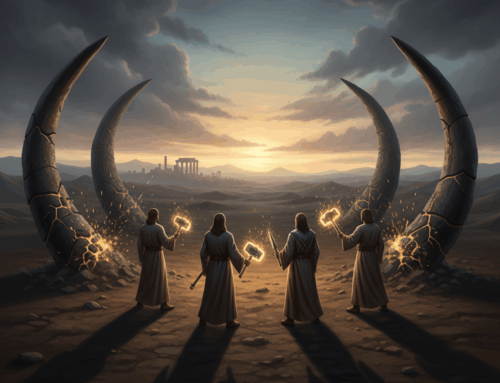
1 Again I lifted my eyes and saw, and behold, four chariots came out from between two mountains. And the mountains were mountains of bronze. 2 The first chariot had red horses, the second black horses, 3 the third white horses, and the fourth chariot dappled horses—all of them strong. 4 Then I answered and said to the angel who talked with me, “What are these, my lord?” 5 And the angel answered and said to me, “These are going out to the four winds of heaven, after presenting themselves before the Lord of all the earth. 6 The chariot with the black horses goes toward the north country, the white ones go after them, and the dappled ones go toward the south country.” 7 When the strong horses came out, they were impatient to go and patrol the earth. And he said, “Go, patrol the earth.” So they patrolled the earth. 8 Then he cried to me, “Behold, those who go toward the north country have set my Spirit at rest in the north country.”
9 And the word of the Lord came to me: 10 “Take from the exiles Heldai, Tobijah, and Jedaiah, who have arrived from Babylon, and go the same day to the house of Josiah, the son of Zephaniah. 11 Take from them silver and gold, and make a crown, and set it on the head of Joshua, the son of Jehozadak, the high priest. 12 And say to him, ‘Thus says the Lord of hosts, “Behold, the man whose name is the Branch: for he shall branch out from his place, and he shall build the temple of the Lord. 13 It is he who shall build the temple of the Lord and shall bear royal honor, and shall sit and rule on his throne. And there shall be a priest on his throne, and the counsel of peace shall be between them both.”’ 14 And the crown shall be in the temple of the Lord as a reminder to Helem, Tobijah, Jedaiah, and Hen the son of Zephaniah.
15 “And those who are far off shall come and help to build the temple of the Lord. And you shall know that the Lord of hosts has sent me to you. And this shall come to pass, if you will diligently obey the voice of the Lord your God.” [1]
We’ve come to the end of a series we’ve been following over the last two months in this great night vision of the prophet Zechariah. The context of that vision is familiar to some of us and simply explained. In those days, God had done some very remarkable things among his people. The last century of their existence had been punctuated by some of the most momentous events in all of Jewish history.
First of all, by the exile in Babylon, where you may remember Daniel and his companions had stood so bravely, courageously, for the name of the Lord. And then in fulfillment of prophecies that Isaiah had given, and particularly the prophecies that Jeremiah had given after 70 years of exile and captivity, God had moved in the heart of a pagan king called Cyrus. And through Cyrus’s intervention, the people of God had been brought back to the promised land and called by God, first of all, to rebuild the broken-down city of Jerusalem, and also to raise up again the temple of God, in order that Jerusalem might again be as the focal point of the church in the Old Testament period, might be the place where God was praised, the place to which, as many of the Psalms said, the nations of the earth would come in order that not only the Jewish people, the descendants of Abraham, but that to the ends of the earth, men and women and young people might come to a living faith, to a covenant salvation, entrusting in the promises and the goodness of God.
And God was exceptionally good to his people, so good that Zechariah’s older contemporary, Haggai, was able, in his prophecy, to speak about the abundance of material blessing. They were able to panel their houses beautifully. And yet despite that, the temple of God lay in ruins. And there was much opposition to its rebuilding. There was opposition from the outside There was the opposition of carelessness, lethargy, and spiritual indifference on the inside. And so God began to speak. And he spoke in two simple ways.
First of all, he spoke through providence. He made life a little more difficult for his people. They began to suffer need. Plenty was no longer the order of the day, and they were forced to ask the question, “Why has God withdrawn these material blessings from our lives?” And then alongside his providences, he sent his prophets. Alongside the actions of his hand, he sent the words of his mouth. And these two prophets, Haggai and Zechariah, began to speak.
Zechariah has, at the beginning of his ministry, this extraordinary night vision It extends from the middle of the first chapter to the end of the sixth chapter. One long vision in which God sets before him a tapestry describing vividly, magnificently, the way in which he will fulfill his sovereign purposes, to bring the glory of his name to the ends of the earth. We have seen that it is, like any ordinary tapestry, a series of patterns, a series of pictures. And yet, as we look at these pictures with Zechariah, each one seems to come to life. And as we go through them, we eventually begin to discover that not only each panel in this tapestry, but the whole tapestry has a pattern and a message. And at the center of it stand two figures: Joshua the high priest and Zerubbabel the king. And they are there as representatives, types of God’s coming Messiah. The Messiah who would, at the last, come to the very temple God was telling them to rebuild.
But on each side of those two central figures there are patterns that speak about opposition to what God is doing and what God is saying. Opposition that comes from outside and opposition that comes from inside. And then at the very edges of the tapestry, in the first chapter and now here in the sixth chapter, we’re given balanced pictures that are intimately related to each other.
BALANCING ACT
In the first chapter, there was a picture of reconnaissance officers sent out by the angel of the Lord, the Lord himself, to see what was happening among the nations of the world while Jerusalem lay in ruins. And they came back to the Lord and said that the nations of the world were resting in their sense of self-satisfaction. while the people of God were minimized and marginalized. And now, as we see right at the other side of the tapestry, we have a balancing picture.
GOD’S CHARIOTS
Horses appear again. Like in the first chapter, they are colored horses. At this time, they are not horses returning to the Lord. They are horses going out from the Lord. These are the chariots of God. who are going to the ends of the earth to fulfill God’s purposes. And this whole chapter, as you would see if you’re using the New International Version, breaks down very simply into two sections. The first is the section that describes the chariots of God that go out from his presence. The second is the section that speaks about the Messiah of God who establishes his kingdom. And I want us briefly to look at these two things this morning.
Taken together, the entire passage contains the theme of the gospel of the Lord Jesus Christ going out to the ends of the earth, not as a divine afterthought but as God’s plan from the beginning of the ages. What’s the significance, then, of this magnificent scene, these colored horses pulling the chariots of God? Unlike the horses in chapter 1, They are not recently returned. They are itching to go.
Verse 7, The powerful horses went out and were straining to go throughout the earth. And you see the picture that Zechariah sees as he gazes up at the last of these panels, and he sees these chariots and the multi-colored horses, and suddenly they begin to move towards him. And he says, Before me, verse 1, were four chariots coming out from between the two mountains, mountains of bronze. We have noticed in our studies in Zechariah how almost everything Zechariah sees is a kind of echo, a reminder of something with which he was more familiar in the story of the city of Jerusalem and the temple that God had built.
And it seems here, as he’s conscious of the need to build this temple in order that God might be glorified, the two great bronze pillars that had been built by Huram, in 1 Kings chapter 7, massive pillars that stood at the portico of the entrance to Soloman’s temple in Jerusalem, these great bronze pillars, fifty feet high, huge in their circumference. Suddenly, in Zechariah’s vision, the pillars are transformed into mountains, and through those bronze mountains there come forth these four divine chariots. Zechariah would have been reminded of the vision that Ezekiel had of the presence of God being brought forth by four chariots moving along with God coming out of the very holiest place of all, coming out with the Ark of the Covenant, beginning to move, borne by four strange creatures.
And it’s as though that vision of Ezekiel suddenly takes on immense size. And he has this sense of God coming forth from right in the midst of the temple, from the holiest place of all, and God is now in the power of his Spirit. You see the reference to the four spirits of heaven in verse 5. God is going out in the power of his Spirit, and he is going to reach out to the very ends of the earth. So as Zechariah once again asks his question. Verse 4, I asked the angel who was speaking to me, who had interpreted this tapestry so well for him, ‘What are these, my Lord?’ The angel answered me, These are the four spirits of heaven, or as we might say, the four-fold Spirit of God, going out from standing in the presence of the Lord of the whole world.
And you see they shoot up to the north, and they shoot down to the south, and then they strain to go throughout the whole earth. And we’re told at the end of the passage, Then he called to me, ‘Look, those going toward the north country,‘ as though he were giving a little sample of what the result was. Those chariots going towards the north country have given my spirit rest in the land of the north. And if you’d been with us over these weeks, that would be a statement of immense significance. Because this whole vision began with Zechariah hearing that these reconnaissance officers had returned from scouting the whole earth, and their response to the Lord was this: the whole earth is at ease and at rest, content and undisturbed in its total self-satisfaction, in its disinterest in God’s glory, and in its delight that God’s church now lies in ruins.
And now, by the end of the story, he is given this great picture, where it is not the nations of the earth who are at rest, but the Spirit of God who has come to rest because now his purposes are being fulfilled. That language of rest in relationship with God is of intense significance for Zechariah. It’s language that reminds him of what God did at the end of his creation. when he had labored to bring light out of darkness, to bring order out of chaos, to bring fullness into emptiness. You remember how at the end of that first section of the creation narrative we are told that on the seventh day God rested from all his labors. And you remember too how God built it into the pattern of his salvation.
Under Old Testament law, the people could work and plow their land year after year. But the 7th year was to be a Sabbath rest for the land itself. the entire land would celebrate the jubilee, presence of God, and there would be liberty for the captives. And it’s all of this that is invested in this notion of the Spirit of God working, working throughout the earth until he finds a place where he can rest and be satisfied with his work.
And although Zechariah could scarcely have it any notion of it, that’s the picture that eventually in the New Testament comes to its fulfillment. Where? In the baptism of our Lord Jesus Christ. When the waters open, as Jesus stands there, and the heavens are torn in two, and there comes down from heaven, as there had come to the earth to find rest in the days of Noah’s flood, there comes to find rest in the northland, at the river Jordan, of the Holy Spirit, upon the person of our Lord Jesus Christ. as though to say, “It is through this one, alone, that the purposes of God that are pictorialized in the rebuilding of this temple will all come to their final fruition.”
And the thing that is intended to be so encouraging to Zechariah is that whereas he sees the temple in ruins and the nations opposed to the purposes of God and to the building of the church of God, he has been able to see beyond the visible to the invisible. He’s been able to see beyond what men are doing to what God is doing. He’s able to see beyond the ruins in which the church of God seems to lie. to the way in which God is nevertheless fulfilling his glorious purposes.
And we have seen in diverse ways in this tapestry that he is living in a time of opposition, of great weakness, of few resources, of much discouragement, in what he calls in chapter 4 a day of small things. But now his eyes are lifted up beyond those small things to see beyond the visible to the invisible, beyond the small to the great, and to set the small and the difficult and the tedious and the discouraging within the context of what Almighty God is doing throughout all history.
And as he sees that, his perspective on the present is radically transformed. because he sees that even in a day of small things, his faithfulness in small things will be another piece of the great jigsaw puzzle that Almighty God is putting together until his glory is displayed throughout the earth. And you know, from the New Testament’s point of view, that is the essence of faith. If you think about the definition that’s given of faith in Hebrews chapter 11, what is it? It’s the ability to see through the things that are visible to the things that are invisible. It’s the ability to take hold of the promises of God for the future and live, trusting them in the present when you see few of them being fulfilled. From beginning to end of that great narrative of the heroes of the faith, this is their defining quality.
Moses endured by seeing him who is invisible. He learned to view the visible in the light of the invisible, the temporal in the light of the eternal, the human in the light of the divine. And here again, what Zechariah is experiencing is the way in which God turns his perspective on his life outside in and inside out. And the glory of it is the way it nerves him and strengthens him to live today for the day when Jesus Christ will be glorified throughout the earth. And even though there are those around him who are saying, This temple that you are calling us to rebuild is a pathetic little thing, he’s given this vision that enables him to see that no matter how poor and menial it may be in the eyes of men, it is an essential piece in the jigsaw puzzle of God’s purposes, without which God’s purposes will not come to fruition.
And here little Zechariah suddenly realizes that in the economy of God, in the weaving of the tapestry of God, he may be one single slim thread, but without that thread, being faithful to him, the tapestry of God lies incomplete. Blessed is he to whom is given the instinct that can tell God is on the field when he is most invisible. Do you know that great verse in Old Testament Scripture that addresses God as the one who hides himself? And that’s what Zechariah is seeing. He’s seeing the God who seems to be hiding himself in terms of the situation in which the prophet is living, and he gets a glimpse of how profoundly active, how gloriously active God is. As these chariots of God go to all the ends of the earth, straining to get there. And then it is in the light of that, as he looks forward to the way in which God will fulfill his purposes, that he is given this word in verse 9 that brings him to the very heart of the matter.
And so, from verse 9 to the end of the chapter, his vision is fixed, his hearing is fixed, not so much on the chariots of God, but on the crowning of the Messiah. The word of the Lord came to me, take silver and gold from these exiles who had arrived from Babylon. And here is just a little glimpse for Zechariah, a little indication to him. And there’s just this little intimation of it here and now in your own life. There are these exiles who have returned from Babylon, and what have they brought with them? They’ve brought with them silver and gold from that land that was so hostile to the true God of Israel. They have ransacked the treasures of Babylon, just as in a previous generation they had ransacked the treasures of the Egyptians.
And now with those treasures that come from that pagan nation, Zechariah is commanded to take silver and gold and to make a crown, and then to set that crown on the head of Joshua, the high priest, who is described here as he was described earlier on in his representative capacity as the branch. And the branch in the Old Testament was a title for the coming Savior, a title for the coming Messiah. And God is saying to Zechariah, “Get this gold and silver that’s coming from these pagan nations, and out of it, make a crown and place it on the head of the high priest Joshua as a symbol, as a sign of what God is going to do with the branch, with the Messiah.” In Zechariah’s own presence, it’s a living picture of what he had seen more vaguely in the vision, that God was going to all the nations of the earth and that the Spirit of God was going to fulfill God’s glorious purposes throughout the universe.
It’s a picture, a solid but glorious picture, of the way in which the Lord Jesus Christ is going to come and to be crowned, not with a physical crown of silver and gold, but crowned with the nations of men and women who come and trust in him. That will be his splendor, which will be his glory, which will be the great emblem of his kingship and his royalty. And all this, do you notice, is done in the following way. Tell him this is what the Lord Almighty says, Here is the man whose name is the branch, and he will branch out from his place. and build the temple of the Lord. It is he, verse 13, who will build the church of the Lord, and he will be clothed with majesty, and will sit and rule on his throne, and he’ll be a priest on his throne, and there will be harmony between these two, that is, between these two ministries, that were always kept separate in the Old Testament, of the priest who offered sacrifices for the sins of the people and the king who reigned over the people.
As Zechariah is able to put the vision of God and the Word of God together, this most remarkable picture of the person and of the work of the Messiah, the Lord Jesus Christ, how he comes to be the priest who will make sacrifice of himself to bear away the sins of the world. How he will be the one who will be crowned by God as his Christ, as Lord and Master, to whom will be given all authority in heaven and earth. And how, as his Spirit is sent throughout the world to all the nations, that Spirit will find places of rest on the lives of men and women he draws from every tribe and tongue and people and nation into the kingdom of the Messiah. Indeed, if you were able to project yourself forward some 600 years to the day of Pentecost and listen to Simon Peter preaching the first Christian sermon, you would find him echoing exactly the things that Zechariah sees, that the Messiah had come and at the hands of cruel men had been put to death, and yet that death was in the purposes of God as a death that would bring pardon, would be a sacrifice for the guilt of his people.
And that same Christ would be exalted in his resurrection and given the place of triumph and glory at the right hand of the Father. And then from the right hand of the Father, Simon Peter said, he would pour out this Spirit that today you have seen and witnessed outpoured upon the nations as you’ve heard the Gospel preached to you, each of you, in his or her own language from all distinct parts of the world. So that in a single hour, this vision, and this word that Zechariah saw and heard would come to a most glorious fulfillment. And not just a fulfillment, but a magnificent beginning of something that Christ would do from that point onwards until the end of the age. And all of this in one little picture.
And now we have the whole of Zechariah’s night vision: opposition outside, weakness inside, lack of resources available, a day of small things, in which, humanly speaking, there would seem to be almost no point whatsoever in engaging in church building. And yet he’s given this glorious insight into the great tapestry of God’s purposes in the world and in history. And he begins to see that the fulfillment of God’s purposes actually depend upon his faithfulness here and now. And as he is faithful here and now, he realizes that God is building his kingdom and God will fulfill his glorious purposes. It’s no different for New Testament believers as it listened to the apostle Paul speaking about this same thing. He says, We are hard pressed on every side but not crushed, perplexed but not in despair, persecuted but not abandoned, struck down but not destroyed, always being given over to death for Jesus’ sake. But we do not lose heart, though outwardly We are wasting away, yet inwardly we are being renewed day by day. So we fix our eyes not on what is seen, but on what is unseen. For what is seen is temporary, but what is unseen is eternal.
Like Zechariah, Paul has seen the vision of the purposes of God into which his own little life fits as an essential part. And he recognizes no matter how small his function may be, there is a sense in which the completion of the tapestry is dependent on him fulfilling that function. It cannot possibly be a waste of life to serve Christ, to sow into the tapestry of God’s purposes the weaving of your faithful life.
[1] The Holy Bible: English Standard Version (Wheaton, IL: Crossway Bibles, 2016), Zec 6:1–15.