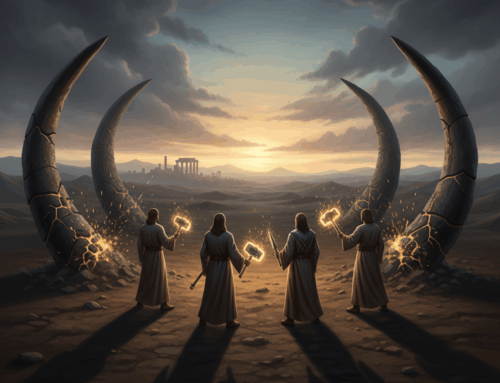

Zechariah 5
1 Again I lifted my eyes and saw, and behold, a flying scroll! 2 And he said to me, “What do you see?” I answered, “I see a flying scroll. Its length is twenty cubits, and its width ten cubits.” 3 Then he said to me, “This is the curse that goes out over the face of the whole land. For everyone who steals shall be cleaned out according to what is on one side, and everyone who swears falsely shall be cleaned out according to what is on the other side. 4 I will send it out, declares the Lord of hosts, and it shall enter the house of the thief, and the house of him who swears falsely by my name. And it shall remain in his house and consume it, both timber and stones.”
5 Then the angel who talked with me came forward and said to me, “Lift your eyes and see what this is that is going out.” 6 And I said, “What is it?” He said, “This is the basket that is going out.” And he said, “This is their iniquity in all the land.” 7 And behold, the leaden cover was lifted, and there was a woman sitting in the basket! 8 And he said, “This is Wickedness.” And he thrust her back into the basket, and thrust down the leaden weight on its opening.
9 Then I lifted my eyes and saw, and behold, two women coming forward! The wind was in their wings. They had wings like the wings of a stork, and they lifted up the basket between earth and heaven. 10 Then I said to the angel who talked with me, “Where are they taking the basket?” 11 He said to me, “To the land of Shinar, to build a house for it. And when this is prepared, they will set the basket down there on its base.” [1]
The great question of the entire first section of the book of Zechariah is: How does God respond and what does God do when he has obviously blessed his people, but his people have begun to take those blessings for granted and show little zeal in obeying him? In fact, as we have seen over these Sundays, there were two prophets faced with that problem. The presumably older one, Haggai, whose prophecy precedes the one which we are studying, and this younger prophet, Zechariah.
They both were raised up by God in precisely the same year before Christ. The people of God had been marvelously, miraculously restored from their 70 years of captivity in Babylon. They had been brought back by God’s design and with God’s command to rebuild the broken city of Jerusalem and to restore its fallen temple. But despite that, as Haggai indicates to us they had made for themselves houses of comfort in these years and done too little to restore the symbols of the glory of God upon the earth, the great city of Zion, and the temple where God had promised to show his glory to his people. And now God was himself breaking into the situation, calling them to repent. And he does this as he always does it, first of all, by divine providences. The people had sown much, Haggai tells us, but they had harvested little.
They had grown accustomed to the Lord’s blessing. They had grown, however, indifferent to the Lord’s commands. And so, first of all, the Lord had withdrawn the evident signs and tokens of his blessing in order that they might ask themselves, “What has gone wrong with our lives?” And then God, having sent these providences, sent his prophets to interpret the meaning of these providences, and to call the people, as Haggai and Zechariah did, to repentance, and to faith, and to new obedience to rebuild the temple of God. It was an overwhelming task.
These men were faced with daunting odds. They were called to minister God’s Word to a people who had grown indifferent both to God and his Word. And so in this great night vision that we’ve seen extends from chapter 1 through chapter 6 of Zechariah, this prophet is given an extraordinary insight into the power and the majesty and the purposes of God to hold on to him, to encourage him, and to enable him to share that vision with those who were faithful, that they might be encouraged in difficult days to go on serving the Lord. And that night vision is, in a wonderful way, really almost like a multimedia presentation, as we’ve seen.
It seems to be like a moving tapestry, with a series of eight panels, and Zechariah’s eyes have been drawn from panel to panel. And as he looks at one part of the tapestry, it comes to life. And then he’s encouraged to look at the next part, and so on, into the central parts that we’ve looked at the last couple of weeks. And now, as his eye moves on, he moves towards the right-hand edge of the tapestry. And he begins to see something rather wonderful. It is that this tapestry is not only alive with images that teach him about the power of God, but there’s a shape to it, there’s a design to it.
In each part of the vision, Zechariah sees familiar earthly images that God uses to teach heavenly lessons. The vision now moves from outside Jerusalem to within. He sees Joshua the high priest and Zerubbabel the Prince. After seeing God’s plans through them and ultimately through Christ Zechariah’s perspective shifts outward, witnessing renewed opposition. And eventually, as we’ll see next Sunday, his eyes are taken to the very end of the tapestry where he’s looking to the very ends of the earth.
In our vision this morning, he’s outside the city again because the theme is opposition that there is to God’s work. But it’s not opposition that’s coming from the nations. It’s opposition that is arising within the community of God’s people. This is represented to him in two of the most unusual sights that he sees. In the first few verses of chapter 5, the flying scroll. And then from verse 5 to the end of the chapter, this extraordinary, almost amusing, if it weren’t so awesome, vision of the woman in the basket.
FLYING SCROLL (5:1-4)
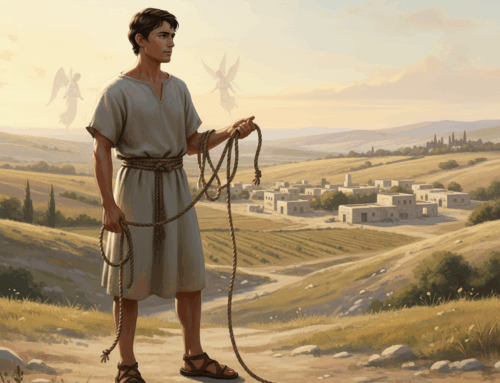
First of all, stand where Zechariah is standing and try and see this flying scroll. I looked again, and there before me was the flying scroll. And there’s much about it that arrests his and our attention. The most obvious thing is its size. It was more like one of those vast advertising banners that you see. This was not simply a banner. This was a vast scroll. He describes it as 30 feet long and 15 feet wide. And usually in the Bible, when we are given little details like that which seem to be incidental to what’s being described, usually those details have got some kind of significance. He could, after all, have said it was just a vast scroll. But he tells us very precisely that it was 30 feet long and 15 feet wide. And the significance of that probably lies in two parts of God’s temple that were exactly this proportion.
The first of them, at least as you went into the temple that you would have encountered, was the porch at the front of the temple. It was the place where, particularly through the priests, God’s judgments would be expressed to the people. And it was exactly this size, we’re told in the first book of Kings. It was thirty feet long, and it was fifteen feet wide. And Zachariah, as a man who knows his Bible well, is presumably intended to reflect back on what he has seen before.
And then, if you had been able to follow through the porch into the temple and as the high priest did on only one day every year, being able to get into the holiest place of all, you would have found another space that was exactly, from the side-on view, the proportions of this flying scroll. It was that area in the holiest place of all where the Ark of the Covenant was kept, and where these great cherubim, that were a huge height with their vast wingspan. And in these two ways that are associated with God’s temple, where God had promised to dwell with his people, where he promised to come forth to his people, Zechariah is immediately given the sense that whatever the message that’s written on this scroll, it comes as the judgment of God from his temple, and indeed from the very holy presence of God into which only the high priest may dare to enter once a year, and that carrying a sacrifice for himself as well as for the people.
And written large on it so that its message cannot be hidden, so that it cannot be ignored, so that no one among God’s people can say they didn’t know, or didn’t see, are words written on one side and on the other side, just as you remember the tablets of stone that Moses brought down from Mount Sinai were written on both sides. And on one side there is written a representative commandment of that part of God’s law that deals with our relationships with each other. And on the other side, a representative commandment from that part of the Ten Commandments that deals with our relationship to God. And in this symbolic way, it is so clear what this is. This is the holiness of God coming forth from the midst of his temple in majesty and power and bringing to the people of God these great charges, that they have become an unrighteous people and they have become an ungodly people.
The very two things you remember Paul speaks about in Romans 1:18, The wrath of God is revealed from heaven against all ungodliness, that’s breach of the first four commandments, and all unrighteousness, that is, all breach of the last six commandments. And God is coming in holy judgment upon his people. And you’ll notice the language that is used in verse 3, “This is the curse that goes out over the face of the whole land. For everyone who steals shall be cleaned out according to what is on one side, and everyone who swears falsely shall be cleaned out according to what is on the other side.” [2]
This is a huge symbolic representation that the curse of God is falling upon his people. Now, it’s important for us to remember what that meant for these people. If you know the closing chapters of the book of Deuteronomy, you’ll remember them particularly because verse after verse, you are told that if the people respond to God’s covenant promise of grace and mercy in faithfulness and obedience, then they will enter into all the blessings of God’s covenant. But if they turn away from God and from his covenant promise, from his promise of grace and salvation and blessing, if they turn away from that, then what they will turn towards will not be neutral territory.
They will turn towards the judgments and the curses of God. And that’s the way in which the end of the book of Deuteronomy sets before us the great issues of life and death. There are, at the end of the day, only two ways to respond to God, to respond to his grace, to respond to his word, to respond to his commandments. One is in trust and obedience that brings us into the experience of his blessing, and the other is in rejection and rebellion and hard-heartedness and unfaithfulness and faithlessness that brings us into the desert land in which we taste his judgment curse.
We do that by being banished from his presence. And the interesting thing of course about being banished from his presence is that you no longer sense or experience God’s presence. To the unbeliever, to the rebel, that is a condition of great ease. He reads this and he says, “Well, I don’t even feel God’s presence. Why should this bother me?” And Zechariah has the wit and wisdom to see written in this vision, that’s the very reason you should be perturbed. When Paul says all human beings are naturally dead in sin he means they cannot feel God’s presence in his judgment. The dead don’t feel God. That is why God promises to utterly destroy the stuff they worship in verse 4. Their idols of wood and stone will be consumed. They may outwardly pretend to be the people of God, but at the end of the day God’s words of judgment will search them out from his holy temple and he will mark them out as the false believers they are, and he destroys the wood and stone of their idols.
BASKET OF EVIL (5:5-11)
he second part of the vision, perhaps a second vision, the picture of the woman in the basket is similar to the scroll vision but takes the story even further. It’s pretty clear that these two pictures that he sees are connected together. 5 Then the angel who talked with me came forward and said to me, “Lift your eyes and see what this is that is going out.” You catch the sense that he sees something in the distance that’s moving perhaps towards him, but he can’t make it out very clearly. But as it comes near, he says, “What is it?” And the angel replied, “It is a measuring basket.” It is an ephah, a basket or a container that would hold somewhere between five and ten gallons of contents. Not a particularly huge basket, but a basket nevertheless of some size. And then, you notice the angel adds, this basket is the iniquity of the people throughout the land.
Actually, the word that is used really represents eyes and therefore if you’ve got a New International Version with footnotes, you’ll notice the alternative translation “appearance.” That is to say, this basket is the appearance, a kind of physical symbol of the iniquity of the people throughout the land. This is what they are like. And then an amazing thing happens. The cover of this basket, the cover of lead, literally the talent of lead, 75 pounds in weight. The cover of lead on this relatively small basket is raised, and inside the basket sits a woman. Of course, he asks the obvious question. Who is this? What is this? And the angel seeing the look on Zechariah’s face of astonishment says, “This woman is wickedness.” She doesn’t seem large if she can fit in a 10 LB bucket. She is, in fact, about the size of a household idol, a demon worshipped in secret by the pretend Israelites who have been judged by the scroll.
Now I know the question you’re asking, Why a woman? And the answer to that question is probably because “wickedness” in the Hebrew language, which Zechariah was writing in, is a feminine noun. And not only so, but it’s a word that actually rhymes with the Hebrew word for ‘woman’. The Hebrew word for ‘woman’ is ‘ha-isha’. And the Hebrew word for wickedness is ha-risha. There’s the obvious reason why here woman is wickedness.
Notice what happens in verse 8. He pushed her back into the basket, and he pushed the lead cover down over its mouth. And as Zachariah sees this, he is seeing an almighty struggle between this angel and the woman in the basket. The verb that’s used here is the verb that’s used of Moses throwing down the tablets of stone when he saw the idolatry of the people. Throwing down those crushed stones is an action of power and energy. And we are to understand that simply to get this lead weight, this substantial lead weight down on top of this woman and to keep her into the basket, it takes a tremendous effort on the part of this visiting angel.
And then, certainly to prove that Zechariah is not particularly interested in the fact that women are wicked, he looks up and there before him he sees two women with the wind, or as you know the word in Hebrew for wind, ruach, is the same word that’s used for spirit. Two women with the Spirit of God in their wings the Spirit that Zechariah had read about in the prophecy of Ezekiel when, you remember, in the valley of dry bones, God had said to Ezekiel, Ezekiel, speak to the wind, speak to the Spirit, and he spoke to the Spirit, that is, he prayed to the Spirit, and the Spirit came, and these bones that had been attached to one another now had flesh put upon them, and they came to life. These women are symbols, it seems, of the power of God, of the Spirit of God coming and dealing with the iniquity of God’s people.
They had had substantial wings, and they lifted up the basket between heaven and earth. Where are they taking the basket? They’re taking it where it belongs. It belongs to this wickedness in Babylon, the country from which the people had been taken by God’s gracious saving, restoring deliverance. Wickedness is going to be taken back there because that’s where it belongs. Just as had been true earlier on in the days of the Exodus, God had taken the people out of Egypt, but Egypt was never taken out of the people. So now he had taken them out of Babylon, but Babylon, their desire for that world of material plenty, of superficial satisfaction, that reeked of ungodliness, their desire for those old days. Well, if they desired those old days, God is saying they can have those old days. And wickedness is taken back to where she belongs, verse 11, to the country of Babylonia, to build a house. That is an idol temple, a ziggurat with horns.
Now when we stand back from these two pictures that Zachariah has just seen coming before his eyes, when we take them together as I think they’re probably meant to be taken, there is something particularly haunting about what God is doing here. The curse that comes from God and enters the house and stays overnight and brings destruction, what does that remind you of? Doesn’t it remind you of the night of the Passover, the night when the Exodus, deliverance, salvation of God’s people began? And God, through the angel of death, came, and he passed over the houses of his own people, but then he entered into the houses of the Egyptians, and he stayed the night and brought the judgment of God upon that nation that had stood so arrogantly against God’s purposes.
What God is saying here is that when his professing people do not possess the obedience they profess to him, then their lives, in terms of the Old Testament, are as if there had been no exodus. and as if there had been no restoration from Babylon. And it’s interesting, you remember, if you know the letter to the Hebrews in the New Testament, how often the letter to the Hebrews says that in other terms. It says if God has brought you in pilgrimage out of your bondage in this world and you go back to that world, or you live in pilgrimage as though you longed to go back to that world, then the day may well come when you trample underfoot the blood of God’s covenant in Jesus Christ and have no more to do with him.
But then you notice that Zechariah sees these women with the wind or spirit in their wings, carrying off this basket of wickedness away. And in a very interesting way, Isaiah 63, with which Zachariah was very familiar, gives us insight. There, God speaks about the way in which it was through the power of the Spirit that he brought his people out of the land of slavery through the wilderness, into the Promised Land. But, he says, they rebelled against his Spirit, and they grieved him. And they became as a people who had never been brought out. And here is a picture of the Holy Spirit.
The Holy Spirit is picking up wickedness, this community of resistance among God’s people, and putting them back into Babylon as though there had never been a restoration. You remember how Hebrews chapter 6 teaches how impossible it is for people like this to repent again. And in it all, God is underlining for his servant this great truth that God will deal with the wickedness of his people in his own way and in his own time.
God will have his temple built by holy hands and by none other. And that is a prophetic message. Because that’s what happened. God had his temple built by the only one who had holy hands. There was no other good enough to pay the price of sin. He alone could unlock the gate of heaven and let us in. Christ. And how did Christ do it? Oh, the amazing thing is that Christ did it by taking all this upon himself. By being banished from the land. By hanging between heaven and earth, banished by man, banished by God, with no companion to help or assist him, and no word from God to comfort him as he cried out, “My God, why have you forsaken me?”
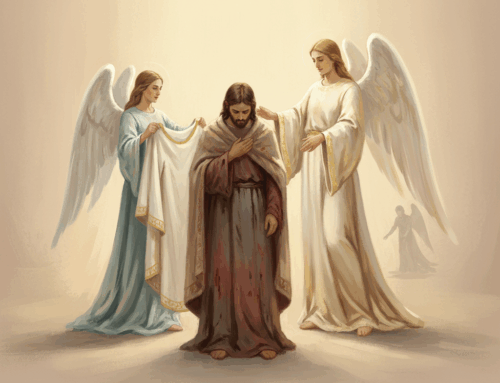
And the answer is here, God was banishing His Son from the land. Just as God was pressing down upon him like a great lead weight the sinfulness of those for whom he would die. Says the apostle Paul in 2 Corinthians 5:21, He was made sin for us. That could just as well have been, He was made wickedness for us, in order that through him we might be made the righteousness of God. And so in a way that Zechariah could hardly begin to understand, God would remove the filth of his people and clothe them in white vestments. He did not understand that perfect blood would need to be shed, that a sacrifice would need to be made, that the shepherd who was the shepherd of God’s people would be violated and destroyed in order that God’s sheep might be preserved and saved.
Although we have not personally experienced Zechariah’s night vision, we have seen in Jesus Christ something infinitely more wonderful. The one who is really able to build God’s temple and to bring us into it because he has been banished from the land instead of our being banished. Because he has borne the overwhelming weight of the guilt of the sin of those who are wicked, because he has been carried away into that awful night land that he experienced in Gethsemane and on Mount Calvary. There the Son of God felt alienation from his own heavenly Father. Because God was determined to build a true and lasting temple.
Now here is one final thought for us from this text. God’s new and true temple is not a place. The New Jerusalem is not a place. It is not a building. God’s new and true temple is the Lord Jesus Christ. But it is also all the people who are trusting into the blood shedding death of the gloriously risen and ascended Savior. Peter wrote:
As you come to him, a living stone rejected by men but in the sight of God chosen and precious, 5 you yourselves like living stones are being built up as a spiritual house, to be a holy priesthood, to offer spiritual sacrifices acceptable to God through Jesus Christ. 6 For it stands in Scripture:
“Behold, I am laying in Zion a stone, a cornerstone chosen and precious, and whoever believes in him will not be put to shame.” 7 So the honor is for you who believe, but for those who do not believe, “The stone that the builders rejected has become the cornerstone,” 8 and “A stone of stumbling, and a rock of offense.”
They stumble because they disobey the word, as they were destined to do.
9 But you are a chosen race, a royal priesthood, a holy nation, a people for his own possession, that you may proclaim the excellencies of him who called you out of darkness into his marvelous light. 10 Once you were not a people, but now you are God’s people; once you had not received mercy, but now you have received mercy.
11 Beloved, I urge you as sojourners and exiles to abstain from the passions of the flesh, which wage war against your soul. 12 Keep your conduct among the Gentiles honorable, so that when they speak against you as evildoers, they may see your good deeds and glorify God on the day of visitation. [3]
[1] The Holy Bible: English Standard Version (Wheaton, IL: Crossway Bibles, 2016), Zec 5:1–11.
[2] The Holy Bible: English Standard Version (Wheaton, IL: Crossway Bibles, 2016), Zec 5:3.
[3] The Holy Bible: English Standard Version (Wheaton, IL: Crossway Bibles, 2016), 1 Pe 2:4–12.