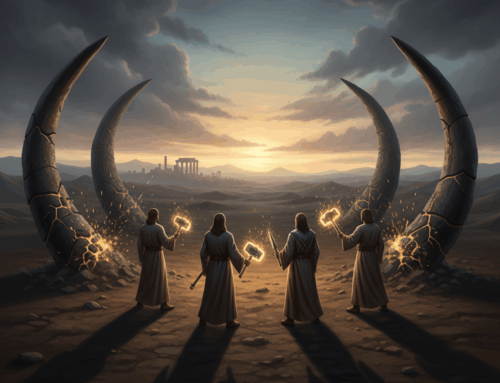

Zechariah 4
1 And the angel who talked with me came again and woke me, like a man who is awakened out of his sleep. 2 And he said to me, “What do you see?” I said, “I see, and behold, a lampstand all of gold, with a bowl on the top of it, and seven lamps on it, with seven lips on each of the lamps that are on the top of it. 3 And there are two olive trees by it, one on the right of the bowl and the other on its left.” 4 And I said to the angel who talked with me, “What are these, my lord?” 5 Then the angel who talked with me answered and said to me, “Do you not know what these are?” I said, “No, my lord.” 6 Then he said to me, “This is the word of the Lord to Zerubbabel: Not by might, nor by power, but by my Spirit, says the Lord of hosts. 7 Who are you, O great mountain? Before Zerubbabel you shall become a plain. And he shall bring forward the top stone amid shouts of ‘Grace, grace to it!’”
8 Then the word of the Lord came to me, saying, 9 “The hands of Zerubbabel have laid the foundation of this house; his hands shall also complete it. Then you will know that the Lord of hosts has sent me to you. 10 For whoever has despised the day of small things shall rejoice and shall see the plumb line in the hand of Zerubbabel.
“These seven are the eyes of the Lord, which range through the whole earth.” 11 Then I said to him, “What are these two olive trees on the right and the left of the lampstand?” 12 And a second time I answered and said to him, “What are these two branches of the olive trees, which are beside the two golden pipes from which the golden oil is poured out?” 13 He said to me, “Do you not know what these are?” I said, “No, my lord.” 14 Then he said, “These are the two anointed ones who stand by the Lord of the whole earth.” [1]
On the 18th of December in 520 BC, a priest named Zechariah stretched out on a cold winter’s night after a long day’s ministry in the temple and fell asleep. As he slept, a dream came to him. But this was no randomly self-generated dream. This was a grand vision from YHWH meant to be given to the people of Jerusalem and Judah.
The circumstances of the vision are simple. Israel has been allowed to return to its homeland after 70 years of captivity in Babylon. Rather than rebuild God’s temple, the people concentrated on home improvement projects. For 20 years the people settled in, squabbled with pagans, and went about their lives while the temple was still nothing but rubble. So God responded in two ways. The crops began to fail hitting the people in their pocketbooks and their bellies. Second, God sent two prophets, Haggai and Zechariah, To encourage the people to begin working on the one thing that made them distinctive among the nations, the temple of the one true God.
While Haggai’s message is straightforward and easy to understand (repent and rebuild the temple), Zechariah’s message is full of strange imagery and requires an interpreting angel to help the prophet understand what he is seeing. Zechariah’s vision is like one long tapestry with eight scenes, each of which seems to move as he watches the scene. The last two panels in this visionary tapestry were of the New Jerusalem that the Angel of the Lord is building. In that third panel Zechariah sees the Angel of the Lord with a measuring line as he goes to plat out the great eternal city. He describes to the prophet some of the amazing features of this great new city. It will be too large to be confined within walls. God himself will protect it. Zechariah takes a kind of flyover above the New Jerusalem.
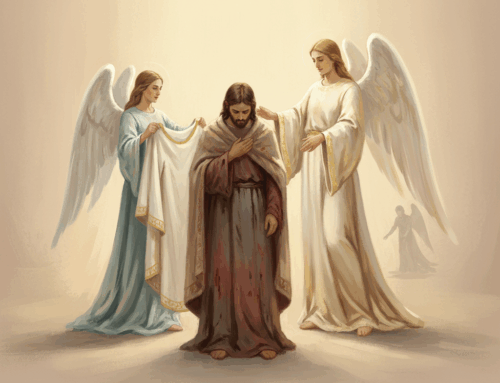
In the fourth scene, he is drawn down to the streets of the New Jerusalem and into God’s glorious temple-courtroom. He witnesses that great eternal scene reminiscent of Job chapter one. He hears Satan, the great accuser, and he sees the high priest Joshua standing in his priestly garments but covered in excrement. Satan is saying that the high priest is just as guilty as all the other Jewish people whom he represents. They have all broken God’s laws and none of them are fit to be in his presence. Then something remarkable happens, the Angel of the Lord rebukes Satan, judging him and silencing him. Then, strictly on his own initiative and out of his own free-will love God orders new clean vestments to be put on the high priest and recommissions him to the priesthood.
These scenes are so intensely glorious that Zechariah is now exhausted and seems to fall asleep in his dream. His interpreting Angel is said to rouse the weary prophet because he has more he needs to see. In this 5th panel Zechariah finds himself still in the heavenly temple of the new Jerusalem but now he is drawn to one object in the temple. Unlike the previous visions, this one unfolds through a series of dialogue prompted by questions. There are four questions in this visionary dialogue. We will examine each of those four questions in turn.
WHAT DO YOU SEE? (4:1-2)
The first question comes in verse 2 when the interpreting Angel asks Zechariah what he sees. Zechariah knows what he sees. He just doesn’t understand what it means. Remember he has been brought into the heavenly temple court of God. And because the earthly temple is a reflection of the heavenly, Zechariah recognizes certain objects in the temple. In the previous section, he recognized his boss the high priest Joshua. Now in this new section he recognizes another familiar temple object, the great golden lampstand blazing with light.
The golden lampstand was present in God’s earthly temple where God was worshipped. It was present in the former Tabernacle as well as a great symbol of God’s glorious presence among his people. You may recall the picture of the Jewish menorah, that great golden trunk with 7 branches (which may or may not have looked like the one in use at the time of Herod’s temple). Overlaid with gold leaf, it represented a golden tree most likely connected to the tree of life in the garden of Eden, acting as a promise of God’s spiritual presence and of his future physical presence.
That theme of God’s bright glorious presence is also reflected in Solomon’s temple where 10 great candlesticks stood between the sacrificial altar and the ark of the covenant. They lit up the room and made the glorious gold sparkle almost like landing lights on an airstrip, Directing the priest from the altar of sacrifice where atonement was made to the very presence of God where the sacrifice was accepted. This particular menorah seemed to have a great bowl sitting atop its main trunk in which sat seven lamps, each with seven wicks on them. Forty-nine lamp lights are blazing. 7×7 is the formula that God used to announce the year of Jubilee and freedom from debt and freedom from slavery. So the lamp is also an illusion to that year when captives would be set free and debts would be forgiven throughout the land. It is beginning to dawn on Zechariah, particularly in these last three visions that God has a greater purpose in mind for his people.
The interpreting Angel asks Zechariah what he sees, but he doesn’t do it to evaluate his eyesight. Zechariah is not asked to count the number of branches on the menorah. He is being asked what this great lamp communicates about God’s plans for his people. Zechariah reports what he sees but does not yet clearly understand. Two olive trees flank the great menorah, constantly pouring oil into the lamps. He asks the Angel “What are these my Lord?” You sense that he’s beginning to understand that this image somehow signifies the presence of God upon his people and that it is safe to approach God and the temple is going to be filled with great glory, but he doesn’t understand the purpose of the olive trees.
DO YOU NOT KNOW?
The interpreting Angel asks the second question: “Don’t you know what these are?” So the Angel begins to explain this strange looking setup of olive trees pressing their own oil somehow and pouring it into the lamp. “This is the word of the Lord to Zerubbabel: Not by might, nor by power, but by my Spirit, says the Lord of hosts. 7 Who are you, O great mountain? Before Zerubbabel you shall become a plain. And he shall bring forward the top stone amid shouts of ‘Grace, grace to it!’”
The interpreting Angel explains the meaning step by step. First, he tells the prophet that what he is seeing is actually a message for Prince Zerubbabel, descendant of King David and governor of the region. It makes sense that Zechariah the prophet is being given a message for the political governor just as he was given a vision of the recommissioning of the high priest. Zerubbabel’s job was to rebuild the city, the temples, and the walls. He had been at it for 20 years with little to show. In other words, he was as useless as a high priest covered with excrement.
The first thing the prophet is told to say to Zerubbabel is this: Not by might, nor by power, but by my Spirit, says the Lord of hosts. Zerubbabel has failed at his task for 20 years. Whatever might or power he could scrape up in himself and among the people simply was not enough to do what God demanded. The high priest was covered in moral filth and David’s descendant was a spectacular failure. Just as the high priest needed God to take away the filth and dress him in pure garments, Zerubbabel needs God’s Spirit to accomplish God’s mission.
God is promising Zerubbabel that if the governor does things God’s way, God will provide his powerful Spirit to accomplish those things. Consider the fact that at the moment of this vision the earthly temple is nothing but rubble. But Zechariah stands in the glorious heavenly temple, which is not so much a physical place as it is the extension of God’s glory. There was no lamp standing in the earthly temple. All of its precious belongings were carted away to the pagan temple treasuries of Babylon long ago. God had commanded the people to keep that menorah in the earthly temple lit at all times. The earthly temple now has no lamp because there is no temple in which to put the lamp. You might recall that was the future profit Samuel’s job, keeping the lights on in the temple through the night. But that light had gone out long ago.
God says that he is in the process of building something that is going to last forever. The meaning, then, is as if he were saying: “Your mind, Zerubbabel, is still so busy with carnal ideas that you are almost asleep, so does it give you an undecided mind. On the one hand, you know that you must, according to the Lord’s word, rebuild the temple. On the other hand, you fear the kings and peoples who oppose you, and consequently you do not get to work. You do not see that you can be equal to the great might and power of your foes. The Lord says that there is no need for weapons, might, or power; that you require none of these; that you need only the light of the Spirit to receive some confidence of mind.”[2]
Gold makes poor weaponry since the metal is too soft. The prophet is not seeing spears, swords, or armor, only a lampstand. He commands him to feel secure against all these. All that is necessary, he says, is faith so that he does not lose confidence in the Lord. Wherever this faith is present, the Lord without question promises that He will repel and crush all weapons, power, and might—however great these may be—even of all the world. The two olive trees represent the full provision of the Holy Spirit’s power pouring into Joshua and Zerubbabel and out to the people.
Here, then, we have a rich text about the confidence of the heart that comes by faith. With that confidence, alert and righteous people are secure against every power of their temporal and spiritual foes. This parallels the external victory over the wicked, where every power and the victorious outcome also lie in resoluteness of mind. Consequently, whoever said, “Hearts are more powerful than hands, for hearts have all power,” seems to have described this precisely. Only that courage conquers which the Lord gives those whom He wants as victors.[3]
In the entire building and construction of the Mosaic tabernacle the Lord meant nothing else than what happens in the world through the ministry of the Word. The table signifies the Word of God. This the Psalm (23:5) reveals very clearly: “Thou preparest a table before me….” Also: “Let their own table … become a snare” (Ps. 69:22).
You see, the Word is food. It feeds us to protect us against the north wind (according to the text of Moses, the table had been set up in that way in the tabernacle), that is, against the temptations of Satan. The lampstand indicates peace because it is made of gold. Wherever the Word is preached, there nothing happens by force, armor, or warfare. Rather, people rest quietly and at peace.
Therefore the lampstand is the ministry of the Word, through the Spirit which teaches and feeds the church. The altar of incense is true prayer, spoken in faith and in the Spirit. True prayer is something which only those can utter who have the Spirit of Christ. The lampstand, however, which the prophet saw in this vision was located between two olive trees. Those trees are Zerubbabel and the high priest Joshua. It is as if He were saying: “There is nothing for you to fear. The Holy Spirit is in your midst. He shines among you. So you need neither weapons nor power. You have Me, your kind and gracious God.”[4] The literal phrase to describe Joshua the high priest and Zerubbabel the Prince are “sons of oil.” When a king or a high priest was invested into office they were anointed with oil. These two trees represent the priesthood and the government of the people with a constant supply of Holy Spirit power.
Then the Lord gives Zechariah another encouraging word for Zerubbabel: 7 Who are you, O great mountain? Before Zerubbabel you shall become a plain. What does that mean? You may have noticed that the Old Testament is quite interested in the concept of mountains as a symbol of something: power. You may recall the recurring phrase Mount Zion. Literally, Mount Zion is the hill upon which the city of Jerusalem stands. To convey the greatness of God’s glory and power it is referred to not as a hill, but as a great mountain. It is a symbol of God’s protection of his people against all the powers of the world, the flesh, and the devil.
You may recall if you have read Haggai chapter 1 that Zerubbabel was moved by God to begin rebuilding the temple about five months before this prophecy was given. But the people began to experience opposition from their pagan neighbors and the work stopped and the people were discouraged. You can read about that opposition in greater detail than in the book of Ezra. God promises to remove the opposition of the world, the flesh, and the devil. Jesus promises his disciples that with faith they could tell the temple mount to be uprooted and thrown into the sea. In fact, that is exactly what they did when they preached the gospel.
The Lord Jesus is not interested in throwing literal mountains into the sea. His promise is that he will crush the head of the serpent. He will flatten out all evil arrayed against him and his people. Zerubbabel began the foundation. But Zechariah is to preach that he will complete the entire temple and put the capstone on top as the people celebrate God’s graciousness to them. The central message of this vision is that God is building his temple where he comes to meet with his people. Because God his building his temple he calls on his people to build earthly temples. But the one in which Zechariah stands is the true heavenly temple, the new Jerusalem that God will bring down.
The first temple God built to meet with his people was creation itself with the Garden of Eden as the holy of holies where God lived on his holy mountain and came down to commune with Adam and Eve in the cool of the evening. If you were to examine the orders for the building of the Tabernacle you would notice that it is filled with so many representations and references to nature, to the Garden of Eden in particular since that was the first temple. When man polluted that temple, God built a tiny movable temple to travel with his people. The lamp in the Tabernacle was there to remind the people of the privilege they forfeited when they polluted the first temple and were rejected by God.
God would continue building his temples to meet with his people until one day, many centuries after Zechariah, the recreative power of the Holy Spirit would move inside of a dark womb to create the ultimate dwelling place of God with man, the God-Man the Lord Jesus Christ, the Man among the Myrtles, the Angel of the Lord. The Lord Jesus becomes a living breathing temple in which God meets with men, lives among humanity, and shares his glory with his people. He becomes the Word of God incarnate. He becomes the glorious temple of the living God and the light of the world. Zechariah and Haggai had no clue what great temple the God of their people was going to build. Before them there were only the makings of a foundation and piles of rubble.
“Chapters 3 and 4 clearly have messianic import. Though in the first place they referred to the reconstruction taking place in Jerusalem in 519 [520] BC, the rock (3:9), the stone (4:7), the Branch (3:8) and the temple all had a significance beyond themselves. Though it is not defined, that significance is connected with the two ‘sons of oil,’ Joshua and Zerubbabel, priest, and Davidic prince, who together are the means of bringing new hope to the community. Through the high priest acquittal is pronounced and access to God’s presence made possible; through the prince the temple is completed and the lampstand allowed to shine out to the world. Two ‘messiahs’ or anointed ones have their roles coordinated; neither is adequate without the other. They are equal in dignity and importance. After the death of Zerubbabel the high priest was to increase in temporal power, for the governors in Jerusalem declined in importance, but the promises to the house of David were not forgotten. The people of Qumran expected two messiahs, one priestly and one Davidic, but the two functions were to be brought together in the person and work of Christ.”[5]
We find the moral of the story in verse 10: 10 For whoever has despised the day of small things shall rejoice and shall see the plumb line in the hand of Zerubbabel. When the people of Judah began to rebuild their temple they wept over a small and seemingly hopeless beginning. When they finally completed the temple they wept again because it was small and shabby and nothing like the glory of Solomon’s former temple. God’s idea of greatness looks nothing like ours! These two sons of oil could not have done a worse job of reflecting human greatness. And yet God fills them up with the glory of his spirit simply because it pleased him to preserve them as part of this system that would produce the ultimate profit, priest, and king.
It was a small thing to most of the world when that little baby was born. And it was a small thing to those disgusted people who passed by one more criminal hanging on a Roman cross. And yet that innocent man was doing something far more glorious than any human being could ever have considered. He was pulling off the excrement covered garments of his people and fitting them with white robes.
6 For while we were still weak, at the right time Christ died for the ungodly. 7 For one will scarcely die for a righteous person—though perhaps for a good person one would dare even to die— 8 but God shows his love for us in that while we were still sinners, Christ died for us. 9 Since, therefore, we have now been justified by his blood, much more shall we be saved by him from the wrath of God. 10 For if while we were enemies we were reconciled to God by the death of his Son, much more, now that we are reconciled, shall we be saved by his life. 11 More than that, we also rejoice in God through our Lord Jesus Christ, through whom we have now received reconciliation.
12 Therefore, just as sin came into the world through one man, and death through sin, and so death spread to all men because all sinned— 13 for sin indeed was in the world before the law was given, but sin is not counted where there is no law. 14 Yet death reigned from Adam to Moses, even over those whose sinning was not like the transgression of Adam, who was a type of the one who was to come.
15 But the free gift is not like the trespass. For if many died through one man’s trespass, much more have the grace of God and the free gift by the grace of that one man Jesus Christ abounded for many. 16 And the free gift is not like the result of that one man’s sin. For the judgment following one trespass brought condemnation, but the free gift following many trespasses brought justification. 17 For if, because of one man’s trespass, death reigned through that one man, much more will those who receive the abundance of grace and the free gift of righteousness reign in life through the one man Jesus Christ. [6]
[1] The Holy Bible: English Standard Version (Wheaton, IL: Crossway Bibles, 2016), Zec 4:1–14.
[2] Martin Luther, Luther’s Works, Vol. 20: Minor Prophets III: Zechariah, ed. Jaroslav Jan Pelikan, Hilton C. Oswald, and Helmut T. Lehmann (Saint Louis: Concordia Publishing House, 1999), 43–44.
[3] Martin Luther, Luther’s Works, Vol. 20: Minor Prophets III: Zechariah, ed. Jaroslav Jan Pelikan, Hilton C. Oswald, and Helmut T. Lehmann (Saint Louis: Concordia Publishing House, 1999), 44.
[4] Martin Luther, Luther’s Works, Vol. 20: Minor Prophets III: Zechariah, ed. Jaroslav Jan Pelikan, Hilton C. Oswald, and Helmut T. Lehmann (Saint Louis: Concordia Publishing House, 1999), 45.
[5] Joyce G. Baldwin, Haggai, Zechariah, and Malachi: An Introduction and Commentary, vol. 28, Tyndale Old Testament Commentaries (Downers Grove, IL: InterVarsity Press, 1972), 133.
[6] The Holy Bible: English Standard Version (Wheaton, IL: Crossway Bibles, 2016), Ro 5:6–17.