
Zechariah 1:18-2:13
18 And I lifted my eyes and saw, and behold, four horns! 19 And I said to the angel who talked with me, “What are these?” And he said to me, “These are the horns that have scattered Judah, Israel, and Jerusalem.” 20 Then the Lord showed me four craftsmen. 21 And I said, “What are these coming to do?” He said, “These are the horns that scattered Judah, so that no one raised his head. And these have come to terrify them, to cast down the horns of the nations who lifted up their horns against the land of Judah to scatter it.”
2 And I lifted my eyes and saw, and behold, a man with a measuring line in his hand! 2 Then I said, “Where are you going?” And he said to me, “To measure Jerusalem, to see what is its width and what is its length.” 3 And behold, the angel who talked with me came forward, and another angel came forward to meet him 4 and said to him, “Run, say to that young man, ‘Jerusalem shall be inhabited as villages without walls, because of the multitude of people and livestock in it. 5 And I will be to her a wall of fire all around, declares the Lord, and I will be the glory in her midst.’ ”
6 Up! Up! Flee from the land of the north, declares the Lord. For I have spread you abroad as the four winds of the heavens, declares the Lord. 7 Up! Escape to Zion, you who dwell with the daughter of Babylon. 8 For thus said the Lord of hosts, after his glory sent me to the nations who plundered you, for he who touches you touches the apple of his eye: 9 “Behold, I will shake my hand over them, and they shall become plunder for those who served them. Then you will know that the Lord of hosts has sent me. 10 Sing and rejoice, O daughter of Zion, for behold, I come and I will dwell in your midst, declares the Lord. 11 And many nations shall join themselves to the Lord in that day, and shall be my people. And I will dwell in your midst, and you shall know that the Lord of hosts has sent me to you. 12 And the Lord will inherit Judah as his portion in the holy land, and will again choose Jerusalem.”
13 Be silent, all flesh, before the Lord, for he has roused himself from his holy dwelling. [1]
It is 520 BC. For roughly 20 years, a band of Jewish people has been allowed to resettle their homeland. But they are surrounded by brutal opposition. The neighbors don’t like them at all. What’s more, because they have neglected finishing God’s temple on God’s holy mountain, their harvests have begun to decrease. God has not spoken to them through a prophet in some time.
But now God has raised up two prophets, Haggai and Zechariah, each of them to encourage the people in their own way. Haggai is much older, a priest who has long since retired from his priestly duties. Zechariah is an actively serving priest, likely the person described in our very text this morning as “that young man” (2:4). It has been two months since Haggai finished his prophecy when Zechariah begins to see and record these night visions. It might be more accurate to call them one night vision. It is a tapestry of scenes strung together and comes with its very own interpreting angels. Zechariah not only sees the still images of the tapestry, but he is also drawn in to interact with the characters as they come to life and act and speak.
What Zechariah discovers is that God’s plans are far grander and greater than he could have imagined. God is not only promising immediate relief in Zachariah’s time but is also promising ultimate relief and ultimate resolution to the problem of evil. In the first panel he had witnessed the mighty power of God displayed in the Man among the myrtles watching over the darkness of the deep. He learns that the Man among the myrtles is also called the Angel of YHWH and both addresses God and himself is addressed as God.
THE CARPENTER
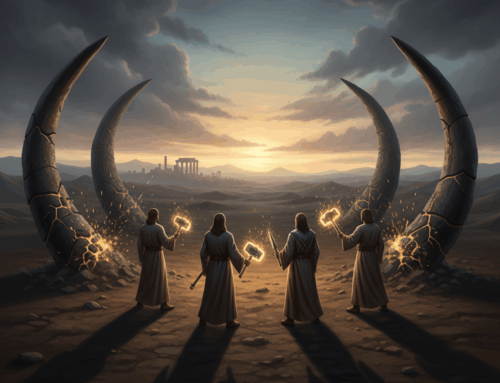
The next panel in his vision is brief both in its description and its promise. The prophet sees four animal horns that convey oppressive power arrayed against God’s people who cower as the horns swing around against them. And we learned from our brief trip through the Old Testament prophetic imagery last week the horns Zechariah sees are actually not on an animal but on a pagan altar that is a miniature version of the great ziggurats of Mesopotamia. Zechariah sees the architecture of evil raising its fist against the most high God by attacking God’s people.
And this oppression was not simply military might. These Pagan nations wormed their way into Israel’s culture and lured God’s people into Pagan practices and Pagan worship. Jerusalem’s head was not bowed low from near economic and political oppression. It was bowed low out of the shame of their own sin and a recognition that they were too sinful to raise up their heads and see their Redeemer.
Now the Angel of the Lord is addressed as YHWH (vv. 20, 21) and shows the young prophet four craftsman, or as other various translations call them, four carpenters. The Greek equivalent of that word is translated “carpenter” and used to describe Christ’s occupation. So we have a small hint here of the work of the ultimate Carpenter to come and his ultimate work of crushing the serpent’s head. The immediate work for the four carpenters is to deconstruct the oppressive evil of the surrounding nations. The evil has been so oppressive that the people of Judah have permanently bowed their heads in shame and embarrassment at their dire situation.
You might recall this to be the theme of this 3rd Psalm:
O Lord, how many are my foes! Many are rising against me; 2 many are saying of my soul, “There is no salvation for him in God.” 3 But you, O Lord, are a shield about me, my glory, and the lifter of my head. 4 I cried aloud to the Lord, and he answered me from his holy hill. [2]
Referring to Jesus, Zechariah (father of John) blesses God because “he has raised up a horn of salvation for us in the house of his servant David” (Luke 1:68, 69). Christ Jesus is the lifting up of the head-horn; it is in him, its head, that the church’s horn is exalted. He is the original that was counterfeited in Babel’s Esagila ziggurat (cf. Deut 30:12, 13; Rom 10:6, 7).
He is the true mountain stairway to God and gate of heaven (cf. Gen 28:12–17; John 1:51), the true altar and tabernacle, the true and only way to the heavenly Father. Jesus is the head lifted up. For God “raised him from the dead and set him at his own right hand in the heavenly places, far above all principality and power and might and dominion, and every name that is named, not only in this age but also in that which is to come; and hath put all things under his feet and gave him to be the head over all things to the church, which is his body, the fullness of him that fills all in all” (Eph 1:20–23).[3]
MEASURING THE CITY
Obviously, Zechariah cannot see from his perspective what the Man among the myrtles plans to do to ultimately resolve evil. But this vision, where the Angel of the Lord plats out the New Jerusalem, let the young prophet know that God’s plans are far greater and more glorious than mere political and economic relief in the short term. The one great overarching promise of the Old Testament was that the Seed of the Woman would crush the serpent’s head. Zechariah only has hints of how that would happen. What he does know from this next panel in the vision is that the Angel of the Lord is making great plans for his city on his holy mountain.
He sees the Angel of the Lord with a measuring rod walking toward the city. This is classic Old Testament prophecy language. Ezekiel has a similar vision in which he too watches an Angel measure the city and the temple. Zechariah is immediately interested and questions the man with the ruler. The Angel replied that he was headed to measure Jerusalem to find its width and its length. Isn’t it amazing? Zechariah is watching a scene in a tapestry, and the scene begins to move. And he is so drawn in he talks to the images. And the man with the measuring rod actually stops and speaks to the young prophet.
Then the Angel with the ruler calls the interpreting Angel over to him and orders him to speak great words of comfort to the young prophet: “Jerusalem shall be inhabited as villages without walls, because of the multitude of people and livestock in it. 5 And I will be to her a wall of fire all around, declares the Lord, and I will be the glory in her midst.’” When the prophets see God measuring out his territory, they understand it is for one purpose. God is making a place to dwell with his people. God is marking boundaries for what is paradise, outside of which is only weeping, wailing, and gnashig of teeth.
This scene is an unfolding of the promise God made in chapter 1:16, “Therefore, thus says the Lord, I have returned to Jerusalem with mercy; my house shall be built in it, declares the Lord of hosts, and the measuring line shall be stretched out over Jerusalem.” The language conveys the idea of open countryside. There will be so many people and so much livestock it simply won’t be possible to hold them all behind conventional walls (2:4-5). Zechariah receives the message that God will not only defend his people, but he will be the one to make them truly flourish again. It will be a city that knows no borders because it does not need them.
What did Cain do after he had killed his brother and God had promised him safety? Cain went out and built the first walled compound in existence because he was evil and he trusted other people were evil as well. He didn’t care about God’s promise of safety. He cared about making himself secure. Measure that against a great city with no walls at all and the only thing that can tell you is that there is no more sin, no more evil to oppress that great city.
This concept must blow poor Zechariah’s mind. He has merely been longing for the temple to be rebuilt and to see construction begin on the walls. What God is promising a huge city with no walls because there will be no evil to oppress that city. God has in effect told the prophet that no one is going back to the old Jerusalem crammed inside a small area behind thick walls. God gives Zechariah 3 promises.
The first is the one we’ve just mentioned, the promise of a new Jerusalem. It is an open city reminiscent of the open Garden of Eden. It appears to have no geographical limitations. And yet it is a city that is protected by God himself acting as a wall of fire. It reminds us of that picture from 2 Kings 6 when Elishah’s servant looks out and sees the surrounding hills covered with enemy forces. But God opens the young man’s eyes to see that the hills are also surrounded by angels in Chariots of fire.
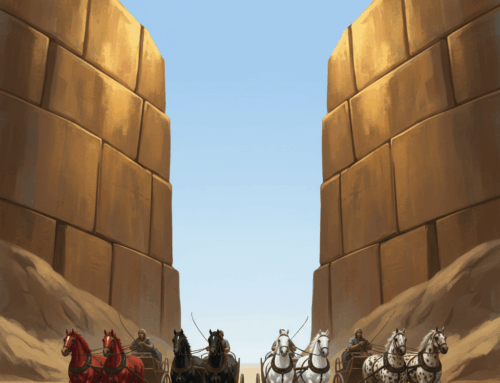
These were the very same Chariots of fire Elishah had seen carry his master Elijah off to heaven. In fact, if you think back to the first vision you recall the man among the myrtles on a red horse but there are others on white horses brown horses and red horses, Suggesting to some commentators the colors of a flame. Fire is a common Old Testament figure used to represent the glory of God. Think of the fiery sword that guarded Eden, or the burning bush that confronted Moses, or the flaming mountain where Moses received the law.
Not only does the city need no walls, it needs no temple. Imagine that? Isn’t that Ezekiel’s primary burden? The people have not gotten around to building a temple. And yet God is platting and planning a new holy mountain city with no temple at all. Revelation 21:23 explains, telling us that God himself will be the glory of this city. God is actually going to come down and live with and among his people. The presence of the temple in the old Jerusalem was its glory. Its greatest glory was that perfectly square holy of holies that housed the presence of the Lord.
You might remember our reading from Revelation 21 last week about the vision the apostle John had of the new Jerusalem. And you may recall I mentioned the dimensions of the new Jerusalem were that of a giant perfect cube, exactly like the dimensions of the holy of holies in the Tabernacle and the temples only vastly larger. And the point of that vision was not that God’s people will live in a giant cube for eternity. The giant cube simply reflects the fact that God dwells there, and he dwells there as he promised, with his people. They shall be his people. And they will dwell with him. That’s the overarching promise of the New Jerusalem. It is a picture of the Angel of the Lord, the Lord Jesus Christ with his people.
What the apostle John said in the opening of his gospel applies to what Zechariah is seeing: 14 And the Word became flesh and dwelt among us, and we have seen his glory, glory as of the only Son from the Father, full of grace and truth.”[4] What he meant is an illusion to these Old Testament promises of the glory of God being permanently in the midst of his people. It was only in Christ, by the power of the Holy Spirit, that people could come to know God. That made Christ the new and true and eternal temple.
The second promise God makes in connection with this vision, in addition to the lack of walls in the temple, is that he will bring about a new exodus in verses 6-7: “6 Up! Up! Flee from the land of the north, declares the Lord. For I have spread you abroad as the four winds of the heavens, declares the Lord. 7 Up! Escape to Zion, you who dwell with the daughter of Babylon.” In verse 9 God gives a promise that is both immediate and future. He will turn the nations upside down so that their own slaves plunder them, just like happened when the Israelites left Egypt. This is exodus language, God calling people out of slavery and into freedom. Remember what Paul said in Galatians? “It is for freedom that Christ has set you free!”
But the people had already returned from Babylon. Yes, there were more still to return. But do you get what Zechariah is seeing here? More accurately, what he is hearing here. Zechariah is hearing the promise of a far greater exodus, but God is putting it in terms that Zechariah could understand, the Babylonian exile and the Egyptian exile. In Luke’s version of Christ transfiguration on a mountain, where the disciples get an unveiled glimpse of the glory of the Lord Jesus Christ, when Moses and Elijah appeared to speak with Jesus Luke tells us that they came to speak about his “exile” (literally). Jesus would accomplish the ultimate exilic liberation.
By comparison, the Egyptian exodus and the Babylonian exodus will seem like nothing! That is because in Christ’s exodus, men and women from every tribe and tongue and nation will be set free fully, finally, and ultimately, eternally free. And you and I here this morning, if you are trusting into the blood shedding death of the resurrected and ascended Lord Jesus as your only hope to see God, you are part of this very exodus. I doubt few of us in this room could trace our lineage back to either the Egyptian or even the Babylonian exodus.
We are part of a new exodus that goes beyond borders and ethnic boundary markers. That is something Zechariah never could have envisioned. Salvation was found only among the people of Israel. One had to enter into the Jewish faith and receive the Jewish rights to be considered one of the people of God. But now, as the apostle Paul explains so very often and so very clearly salvation comes through Christ alone, not through ethnic identity or boundary markers. The Angel of the Lord has moved beyond the borders of Judah, and he calls all of his people out of exile from whatever Babylon or Egypt under which they are being oppressed.
So God has announced a new city, a new temple, and a new exodus. This is a spiritual vision dealing out spiritual realities. So this new exodus is clearly not like the others because it is not entirely physical. It involves a change of affections, not necessarily locations. It involves receiving a new heart, one of flesh and not of stone, and a new mission. And then, in verses 10 through 12, there is this promise of the new land:
Sing and rejoice, O daughter of Zion, for behold, I come and I will dwell in your midst, declares the Lord. 11 And many nations shall join themselves to the Lord in that day, and shall be my people. And I will dwell in your midst, and you shall know that the Lord of hosts has sent me to you. 12 And the Lord will inherit Judah as his portion in the holy land, and will again choose Jerusalem.”
Notice verse 11. There is a phrase there that is used only and exclusively in the Old Testament to describe Israel: “my people.” God is not simply expanding the borders of his holy city, he is opening up its citizenship regardless of tribe, and tongue, and geographic location, to any who will come to him in repentance and dependence. That is something this young priest/prophet could never have imagined. This is the fulfillment of God’s covenant with Abraham in which he promised that all the nations of the earth would be blessed through Abraham.
You know that it is the Lord Jesus Christ, son of Abraham, son of David, who comes down from his dwelling to call both physical Israel and the nations into his glorious new Jerusalem.
13 Be silent, all flesh, before the Lord, for he has roused himself from his holy dwelling.
[1] The Holy Bible: English Standard Version (Wheaton, IL: Crossway Bibles, 2016), Zec 1:18–2:13.
[2] The Holy Bible: English Standard Version (Wheaton, IL: Crossway Bibles, 2016), Ps 3:1–4.
[3] Meredith G. Kline, Glory in Our Midst: A Biblical-Theological Reading of Zechariah’s Night Visions (Eugene, OR: Wipf and Stock Publishers, 2001), 68.
[4] The Holy Bible: English Standard Version (Wheaton, IL: Crossway Bibles, 2016), Jn 1:14.