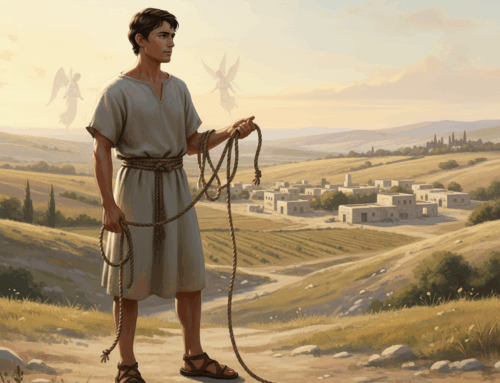

Galatians 4:21-31
21 Tell me, you who desire to be under the law, do you not listen to the law? 22 For it is written that Abraham had two sons, one by a slave woman and one by a free woman. 23 But the son of the slave was born according to the flesh, while the son of the free woman was born through promise. 24 Now this may be interpreted allegorically: these women are two covenants. One is from Mount Sinai, bearing children for slavery; she is Hagar. 25 Now Hagar is Mount Sinai in Arabia; she corresponds to the present Jerusalem, for she is in slavery with her children. 26 But the Jerusalem above is free, and she is our mother. 27 For it is written, “Rejoice, O barren one who does not bear;
break forth and cry aloud, you who are not in labor! For the children of the desolate one will be more than those of the one who has a husband.”
28 Now you, brothers, like Isaac, are children of promise. 29 But just as at that time he who was born according to the flesh persecuted him who was born according to the Spirit, so also it is now. 30 But what does the Scripture say? “Cast out the slave woman and her son, for the son of the slave woman shall not inherit with the son of the free woman.” 31 So, brothers, we are not children of the slave but of the free woman.
When Paul used slavery as an example to describe the effect of the Mosaic Law, it was something everyone in his day – Jew or Gentile – could understand. The economy of Rome was slave-based. With few exceptions, you were either a slave or a slave-owner. If you were a salve, you had been captured in war, or sold by your poor parents who needed the money, or born the child of a slave.
To be born into slavery meant that you were not now, nor had you ever been, a person. You were property. As property your master could sell you, beat you, starve you, use you in any manner that suited him, and even kill you without any criminal charges or social stigma. If you had a skill such as cooking or bookkeeping, or carpentry, you were a valuable commodity who could be sold for a very high price.
Your only chances at freedom were to purchase it from your master (a very rare thing because slaves didn’t earn wages), or for your master to give you freedom (also a very rare thing). Even if you purchased your freedom or were gifted your freedom, you were still looked down upon by the free citizens of Rome. Assuming you accumulated enough money to buy your freedom, you would then have to accumulate more money to buy citizenship from the state if you wised to truly improve your lot in life. Yet you and your family for generations to come would still bear the stigma of having come from slavery.
Assuming you were a skilled slave and performed all your duties so well as to not be starved, beaten, sold, or killed, all you earned was the right to continue to live as a slave. If you had children, they would all be slaves and could be sold off and stripped away from you at any time. Your only, tiny hope was to buy or be gifted your freedom. That slim hope was Rome’s way of keeping most slaves from open rebellion.
So when Paul writes in this passage about being born into slavery, it is an idea every one of his readers would know very well; almost all his readers would be either slaves or slave owners by birth. To call to the nice men from Jerusalem “slavers” would be an insult reminding them the history of Jewish captivity into Assyrian and Babylonian slavery. To call the free Gentiles “slaves” would be an insult to their social status and to their family history. To tell the slaves of Galatia that they are not only real-life slaves, but near-hopeless religious slaves was not positive or encouraging in any sense.
If you haven’t noticed it so far, these first four chapters Paul’s letter to the Galatian churches alternate back and forth between yelling and weeping, between anger and fear, between argument and deep concern. But hope is coming. You could say that “hope and change” start next week with chapter 5. He has told us what Law looks like; he will tell us what grace looks like. But for now, there is one final example for the Gauls that will likely stir them to anger and will certainly get their attention for good or ill, comfort or conviction, consolation or consternation as the Spirit sees fit to work through His Word.
Our passage this morning shows us two “baby mommas” and their children: (1) Hagar the slave woman with her child born into slavery; and, (2) Sarah the free woman with her child born into freedom and citizenship.
-
- Hagar of Sanai (4:21-25)
- The Master (21)
-
-
-
- Paul begins with some cross examination, “Tell me, you who desire to be under the law, do you not listen to the law?”
- Notice that when Paul references the story of Abraham and his baby mommas, he calls the story of Abraham “the law.” When we hear the word “law,” we think of all the places God demands performance.
- But the account of Abraham’s life is not a demand for performance, yet Paul calls it “the law” because the entire first five books of the Old Covenant are referred to collectively as “the book(s) of the law.”
- So to be “under the Law” is to be enslaved by all of the moral, ceremonial, and civil requirements found in the Pentateuch in the slim hope of earning the reward of freedom – just like the Roman slaves.
- In Paul’s example the slave master is not Abraham, but the Law.
-
-
- Two Babies, Two Mammas (22-23)
-
-
-
- 22 For it is written that Abraham had two sons, one by a slave woman and one by a free woman. 23 But the son of the slave was born according to the flesh, while the son of the free woman was born through promise.
- To be the child of a slave is to be a slave. Abraham’s first son, Ismael was born to Hagar the slave woman. By nature, he was a slave. Even though Abraham accepted Ishmael as a son, God did not accept Ishmael as the Promised Seed, the child God had promised to Abraham and Sarah.
- Ishmael was born out of Abraham’s attempt to achieve God’s promise. Abraham waited for God to give Sarah a child, but that was taking too long. Abraham heard God’s promise, trusted God’s promise, but also saw his barren, childless state and decided to take control.
- After all, he wasn’t getting any younger. Imagine all the people Abram met who inquired of this man named “exulted father” as to how many children he had; for 8 decades of his life, Abram had to answer in shame, “None.” In fact, Paul tells us in Romans 4 that Abraham was impotent by the time God announces to him (at age 99) that Isaac will be born within a year.
- So before God came and announced the birth of Isaac as the child of promise, before age had stolen all of his manhood, Abraham took one of his wife’s slaves, Hagar, and fathered Ishmael with her. After all, God had promised a child would come.
- We can’t pick on Abraham. You and I live most of our lives hearing and having that mustard-seed-sized trust in God’s good promises. But we strive to bring them about in our own strength most of the time. Our focus on messy circumstances is so much more natural than the trusting and resting of gospel sanity. Observation is the natural state of the First Adam. Revelation is the supernatural state of the Last Adam.
- Paul compares Hagar and Sara, the two baby mommas. Sara was a free woman. Her child, Isaac, by nature was free. But more than that, Sara’s child had a promise of citizenship in the kingdom God was building through Father Abraham, the man of trust.
- Hagar’s child, Ishmael, had the promise of his own earthly kingdom, but not God’s kingdom. We see this in Gen. 17:20-21 after Ishmael’s birth when God promises the coming of Isaac, the child of the covenant of promise, the ancestor of the Promised Seed Jesus.
- Abraham asks God to recognize the slave-born Ishmael as the Promised Seed. But God says to Abraham, “As for Ishmael, I have heard you; behold, I have blessed him and will make him fruitful and multiply him greatly. He shall father twelve princes, and I will make him into a great nation. 21 But I will establish my covenant with Isaac, whom Sarah shall bear to you at this time next year.”
- Isaac was born of an impotent man and a woman decades past child-bearing years. Isaac was a child of grace, a gift of God’s one-way love. Ishmael is a product of a human attempt to bring about God’s promise in man’s way. And so these two sons and their mothers represent two different relationships, or covenants.
-
-
- Two Covenants, Two Mountains (23-24)
-
-
- But the son of the slave was born according to the flesh, while the son of the free woman was born through promise. 24 Now this may be interpreted allegorically: these women are two covenants. One is from Mount Sinai, bearing children for slavery; she is Hagar.
- Man’s scheming in the flesh cannot please God. That principle applies not only to our salvation, it relates to the accomplishment of God’s will in our Christian service and it pertains to all of the activity of the Church of Jesus Christ. All the schemes that Christians manufacture to accomplish the will of God come under the condemnation of this principle Paul establishes from the life of Abraham.
- Both individuals and churches can scheme in the flesh. Churches can become outcome driven by programing or budgeting. It’s not that programs and budgets are wrong; but reliance on them as schemes to achieve an outcome is a fleshly reliance. It is our nature to take good things as well as bad things and turn them into functional saviors in a works-based covenant.
- Paul says in v. 24, “Now this may be interpreted allegorically: these women are two covenants.” Early church fathers believed that this verse gave them permission to find allegorical meanings for every text in Scripture. But Paul is actually using TYPOLOGY and not allegory. A type always has a corresponding historical and biblical counterpart. King David is a type of Christ. The sacrificial lamb is a type of Christ. But allegory does not have a corresponding historical/biblical counterpart – it assigns higher, hidden meanings to every text in scripture.
- The literal, historical biblical women (Hagar and Sarah) function as types for other literal, historical biblical things. Hagar is a type of the Mosaic Law given on Mount Sinai, culminating in the literal, historical city of Jerusalem and the Jewish temple.
- Sara is a type of the covenant of grace, God’s one-way love, promised to her and Abraham, ratified by the Promised Seed Jesus culminating in God’s heavenly city of the new and true Jerusalem.
- Now, think how absolutely insulting Paul is being here to these good Jewish teachers from Jerusalem who are so proud of their heritage in Abraham and Moses. Paul is says they are NOT children of promise. They are not descendants of Isaac but of Ishmael the pagan slave child (both of whom were circumcised!).
- Paul is insulting the false teachers’ heritage and their identity as Israelites. It would be like announcing to Americans that Osama Bin Laden would be buried at Arlington National Cemetery with full military honors because he was our true hero.
- Paul is pointing the nice men from Jerusalem to an exact opposite view of scripture from the one that informs their culture, their pride, their family heritage, their very sense of identity – all because they had simply added the Jesus to their system of salvation through sacraments and faithful works, refusing to see the radical nature of Messiah’s work.
- The beautiful city of Jerusalem with its marbled, jewel-and-gold-encrusted temple was NOT Sarah’s city but Hagar’s city. It was a city of pagan slavery, not true Jewish heritage founded upon the covenant of grace. It was the poster-child for Semi-Pelagianism; grace + working faith or faithful works.
- Paul is not describing the Mosaic covenant of works as a “gracious covenant;” he puts it under the heading of fleshly works and slavery as over against the Abrahamic promises. One is slavery, the other is grace.
- So Paul writes in Rom. 9:6-8, “For not all who are descended from Israel belong to Israel, 7 and not all are children of Abraham because they are his offspring, but “Through Isaac shall your offspring be named.” 8 This means that it is not the children of the flesh who are the children of God, but the children of the promise are counted as offspring.”
-
- Sarah of Zion (26-31)
- The Mother Ship (26-27)
-
-
-
- Paul writes in v. 26, “But the Jerusalem above is free, and she is our mother.” There are no slaves in God’s kingdom. Unlike Rome, everyone born into God’s kingdom is a citizen.
- Saint Author of Hebrews teaches the same in Heb. 12:18-24, “For you have not come to what may be touched, a blazing fire and darkness and gloom and a tempest 19 and the sound of a trumpet and a voice whose words made the hearers beg that no further messages be spoken to them. 20 For they could not endure the order that was given, “If even a beast touches the mountain, it shall be stoned.” 21 Indeed, so terrifying was the sight that Moses said, “I tremble with fear.” 22 But you have come to Mount Zion and to the city of the living God, the heavenly Jerusalem, and to innumerable angels in festal gathering, 23 and to the assembly of the firstborn who are enrolled in heaven [citizenship], and to God, the judge of all, and to the spirits of the righteous made perfect, 24 and to Jesus, the mediator of a new covenant, and to the sprinkled blood that speaks a better word than the blood of Abel.”
- Paul quotes here from Isaiah 54:1, which Isaiah sang as an encouragement to Israelites about to be enslaved by the Babylonians. When Babylon executed God’s punishment, earthly Jerusalem became be a childless and desolate slave. But one day heavenly Jerusalem would be full of the free children with an eternal, unbreakable citizenship.
-
-
- Birth (4:28-31)
-
-
- Finally, Paul writes: 28 Now you, brothers, like Isaac, are children of promise. 29 But just as at that time he who was born according to the flesh persecuted him who was born according to the Spirit, so also it is now.
- Paul makes the most encouraging statement to the Asian Gauls that he has yet made in this letter. He calls them children of promise. Even in Paul’s anger at the nice men from Jerusalem and their Semi-Pelagian, Jesus + doctrine, Paul knows that God does not lose those upon whom he sets his sovereign, one-way love.
- Paul sees these impressionable Gauls as people persecuted by false doctrine. The Gospel was persecuted by the Law as far back as Ishmael and Isaac, Paul says. It is always grace that is persecuted by legalism, never the other way round. Notice that persecution comes from within, not without. Isaac’s own brother persecutes him. The man of grace is never at peace with the man of works. It was professing members of the church trying to destroy Paul’s gospel labors. Grace makes the Old Adam very angry.
- God’s one-way love attacks the idea that man’s works can have any merit before God, whether in justification or sanctification, and that always stirs the sin-enslaved heart to anger because the flesh always seeks some glory for itself. That is why Abraham was commanded “Cast out the slave woman and her son, for the son of the slave woman shall not inherit with the son of the free woman” (4:30). God’s promise to Abraham had nothing to do with man’s plans and schemes, no matter how well-intentions.
- There are two births in this passage. One is birth according to the flesh, and the other is birth according to the Spirit. Rebirth is the only way to overcome the class distinction of slavery and non-citizenship.
- Our physical birth made us, by nature, children of slavery subjected to the Law written upon our hearts – a law all the sons of the First Adam struggle to suppress or re-write or water down just as the Judaizers watered down the Mosaic Law with cheap grace. For the wrath of God is revealed from heaven against all ungodliness and unrighteousness of men, who by their unrighteousness suppress the truth. 19 For what can be known about God is plain to them, because God has shown it to them (Rom. 1:18-19).
- Sons of the First Adam, born either Jew or Gentile, cannot escape slavery to God’s Law because he wrote even into the hearts of the Gentiles. Gentiles, writes Paul, “…show that the work of the law is written on their hearts, while their conscience also bears witness, and their conflicting thoughts accuse or even excuse them 16 on that day when, according to my gospel, God judges the secrets of men by Christ Jesus” (Rom. 2:15-16).
- Jesus said “Truly, truly, I say to you, unless one is born again he cannot see the kingdom of God. …unless one is born of water and the Spirit, he cannot enter the kingdom of God. 6 That which is born of the flesh is flesh, and that which is born of the Spirit is spirit” (Jn. 3:3-7).
-
How, then does this new birth out of slavery and into freedom and citizenship come? It comes not by purchase out of your slave wages, but by gifting. Jesus said, “For God so loved the world, that he gave his only Son, that whoever believes in him should not perish but have eternal life. 17 For God did not send his Son into the world to condemn the world, but in order that the world might be saved through him. 18 Whoever believes in him is not condemned, but whoever does not believe is condemned already, because he has not believed in the name of the only Son of God” (Jn. 3:16-18).
If you are born again into the promise given to Abraham then no matter where you roam, no matter what trials oppress you in this pilgrim land, you are and ever shall be a free citizen of the heavenly Jerusalem. Sara is your baby momma and your brother is the King of the universe – all by the free gift of God.