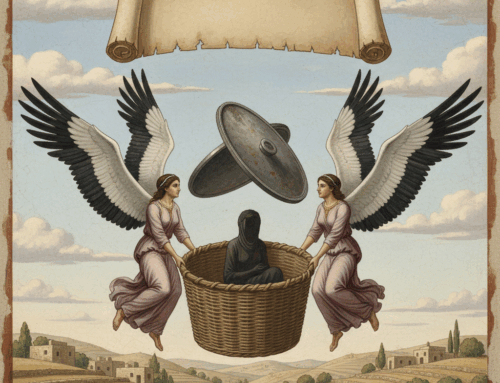

Galatians 3:15-29
Promise: 15 To give a human example, brothers: even with a man-made covenant, no one annuls it or adds to it once it has been ratified. 16 Now the promises were made to Abraham and to his offspring. It does not say, “And to offsprings,” referring to many, but referring to one, “And to your offspring,” who is Christ. 17 This is what I mean: the law, which came 430 years afterward, does not annul a covenant previously ratified by God, so as to make the promise void. 18 For if the inheritance comes by the law, it no longer comes by promise; but God gave it to Abraham by a promise.
Prison: 19 Why then the law? It was added because of transgressions, until the offspring should come to whom the promise had been made, and it was put in place through angels by an intermediary. 20 Now an intermediary implies more than one, but God is one. 21 Is the law then contrary to the promises of God? Certainly not! For if a law had been given that could give life, then righteousness would indeed be by the law. 22 But the Scripture imprisoned everything under sin, so that the promise by faith in Jesus Christ might be given to those who believe. 23 Now before faith came, we were held captive under the law, imprisoned until the coming faith would be revealed. 24 So then, the law was our guardian until Christ came, in order that we might be justified by faith.
Pardon: 25 But now that faith has come, we are no longer under a guardian, 26 for in Christ Jesus you are all sons of God, through faith. 27 For as many of you as were baptized into Christ have put on Christ. 28 There is neither Jew nor Greek, there is neither slave nor free, there is no male and female, for you are all one in Christ Jesus. 29 And if you are Christ’s, then you are Abraham’s offspring, heirs according to promise.
Last week we heard Paul tell us that the Law is a curse because even when we can polish up the outside of our cups and appear to be good Law-keepers, it reaches down into the darkest recesses of our being to judge every thought, every motive, every attitude we have. We can blame culture. We can blame the media. We can blame our circumstances. But God’s good and perfect Law always points to our own hearts.
The concept of Law as curse makes us very uncomfortable because our sin nature is drawn to Law. Our flesh loves to water down God’s Law and turn it into a self-management, self-salvation project. So we view grace as something we can use to dilute God’s Law into good advice for achieving our life goals and meeting our felt needs. “Love the Lord your God with all your heart, and with all your soul, and with all your might” becomes “Love God more than sports on Sunday.” “Love your neighbor as yourself” is diluted into “Do something nice for someone when it not too inconvenient.”
When we are weighed down with guilt over some terrible sin in our past, we turn to cheap, fuzzy law. When we feel victimized by something awful that happened to us in our lives, we turn to fuzzy, keepable rules because we think that will help us control our outcomes, keep bad things at bay and earn us good things. Onto to watered-down Laws of God we add our own “little ‘l’ laws” like “Be pretty” or “Be happy” or “Be the perfect Mom” or “Be the best wage-earner” or “Above all things, be normal!”
Because we all deeply long for that sense of “rightness,” we crave a sense of being in control. The more out of control things appear, the more rules we make for ourselves (little “l” laws) and the more we water down God’s (big “L”) Law. The sin nature gets fat and grace grows thin; the cross gets small.
This morning Paul continues explaining how God’s promise to Father Abraham relates to God’s Law given through Moses by showing us: (1) Abraham’s promise; (2) Moses’ prison; and (3) Jesus’ pardon (the great escape).
-
- PROMISE (3:15-18)
- Contract Law (15)
-
-
-
- V. 15, “To give a human example, brothers: even with a man-made covenant [διαθήκη], no one annuls it or adds to it once it has been ratified.”
- Paul is distinguishing between the promises people make to each other and the promise God made with Abraham. When people enter into legal contracts, says Paul the lawyer, no one party can change the contract terms once the deal is signed.
- We know people break their word all the time. We inherited that trait from the Adams’ – the first deal-breakers. The entire reason we make detailed, written, ratified contracts is to have some means to settle disputes when one party wants to change the terms.
- Contract law is all about keeping your word and having the right to make the other party keep their word.
-
-
- Promise (16)
-
-
-
- V. 16, “Now the promises [ἐπαγγελλία] were made to Abraham and to his offspring. It does not say, “And to offsprings,” referring to many, but referring to one, “And to your offspring,” who is Christ.”
- In v. 15, Paul speaks of contracts. But in v. 16, he uses a difference word for God’s relationship to Abraham: “promises.” This is a very important distinction. Verse 15 speaks of human performance. Verse 16 speaks of God’s one-way promise.
- God did not enter into a two-sided contract with Abraham that required Abraham to do anything at all. God promised Abraham that God would do all the performing: “And I will make of you a great nation, and I will bless you and make your name great, so that you will be a blessing. 3 I will bless those who bless you, and him who dishonors you I will curse, and in you all the families of the earth shall be blessed” (Gen 12:2-3).
- God promises: I will, I will, I will. Abram, I am large and in charge. I have your entire life in my hands. I have your entire family in my hands. You are the father of the Promised Seed. God makes a promise, NOT a two-party contract.
- What happens when Abraham wants control of God’s promise? What happens when Abraham feels threatened? What happens when he thinks he needs to help God fulfill God’s promise? What happens when Abe tries to produce his own “faithful works?” or that he needs to take control to achieve and outcome?
- Abraham pimps out his wife – not once but twice and gets very well paid both times. He hooks up with one of his slave-girls (that he earned by pimping out his wife) and becomes a baby-daddy to race of people utterly given over to moralism.
- And yet, God’s I will NEVER changes! God teaches Abraham about the wages of sin by destroying a city and by requiring Isaac’s life as a sacrifice for which God alone provides the substitute. But he NEVER changes his I will.
- There were times when Abraham saw his greatest need as safety, or wealth, or child planning, or family management, or estate planning. Abraham took control; he tried to manage for a certain outcome; he tried to fix; he tried to win. The world loves a winner.
- God came to Abraham over and over to preach the Good News because Abraham and you and I forget over and over since our sin nature is constant screaming, “Feed me” [Little Shop of Horrors] when it needs to starve to death.
-
-
- Contract as Promise
-
-
- Vv. 17-18, “17 This is what I mean: the law, which came 430 years afterward, does not annul a covenant previously ratified by God, so as to make the promise void. 18 For if the inheritance comes by the law, it no longer comes by promise; but God gave it to Abraham by a promise.”
- Paul talked about the binding nature of contracts. He talked about God’s one-way promise to Abraham. Now he combines the two ideas into one: God’s one-way promise to Abraham is a binding contract that no one can earn. We old-time lawyers call that a unilateral contract – one party’s promise to perform; any other party to the contract need only to rely on the promise.
- Paul calls God’s promise of salvation to Abraham and his children the covenants of promise (Eph. 2:12). God demands no performance from us to keep his Word to us. This is one-way love.
- It is the complete opposite of all those emails and Facebook postings you see claiming that if you share them with others, God will grant you a wish.
- God’s promises are NOT give-to-get contracts even when some well-meaning person electronically perverts them with pictures of angels, Jesus, or an American flag, turning god-talk into witchcraft. Good intentions make BAD theology.
- Paul says “…the concept seed is not to be taken as an indiscriminate quantity but as a unit (concentrated in the person of Christ).” The one-way love God promised came through one seed – the Promised Seed of Genesis 3:15, the Lord Jesus Christ. Moses is not the Promised Seed; Jesus is.
- So when God later makes demands for Israel’s performance through Mosaic Law, it does not cancel his promise of his own one-way performance through Abraham’s Seed.
- But that begs the question, “Why did God demand a two-party contract from Israel (Abraham’s children) when he had already made a one-party contract with Abraham?” How do we resolve God’s unconditional promise with his conditional contract?
-
- PRISON (3:19-24)
- Reasons
-
-
-
- Purpose: The law was given “to make wrongdoing a legal offence” (v. 19a). The law reveals sin (Rom. 3:20; 4:15; 5:13) and it reveals the sinner’s craving to break the rules (Rom. 7:7f., 13).
- Expiration date: until the offspring should come to whom the promise had been made (19b). In other words, opening up a can of Law after Calvary is toxic to your system because its “sell by” date has expired. The sacrificial lamb was temporary flesh. Jesus, to whom the Law pointed, is permanent flesh and the once-for-all sacrifice fully and finally fulfilled. Feasting on expired, rotted sacrificial flesh it will make you deathly ill!
- God’s promise to Abraham has no “sell by” date. “I will be your God, you will be my people, and I will live among you” never expires because it depends not on the performance of sinful people but upon God’s unconditional, eternal one-way love.
- Why the Mosaic Law? To magnify the promise. The uglier our sin, the more beautiful is grace! The Law utterly obliterates our “theology of victory” (the idea that we can control our own desired outcome) and replaces it with the incomparable glory of the “theology of the cross.”
- In other words, I AM NOT A WINNER. I don’t need to win in business; I don’t need to win as a parent or a child; I don’t need to win any popularity contest. I am utterly free to be a loser in this upside-down world because in Christ I have total and complete victory!
- The Law shows me that in the real world of God’s Kingdom, all I can be is a total loser under the curse of the Law unless I trust into God’s unilateral contract that Christ performed on my behalf.
-
-
- Heart and Hands
-
-
- Prison: “But the Scripture imprisoned everything under sin, so that the promise by faith in Jesus Christ might be given to those who believe. 23 Now before faith came, we were held captive under the law, imprisoned until the coming faith would be revealed.”
- The Law was a prison. It held people captive. Paul is not being “over the top” here. He is giving the perfect analogy.
- Luther: “No thief or murderer or criminal who has been captured loves his fetters or the foul prison in which he is held bound. In fact, if he could, he would destroy his prison and his iron shackles and reduce them to ashes. In prison he does indeed refrain from doing evil, not out of good will or out of a love for righteousness but because the prison prevents him.”
- The Law forces us to grit our teeth, gut it out and grind our way through. What kind of righteousness is that which is compelled by fear and driven by the desperation to perform for a certain outcome?
- “…the Law is also a spiritual prison and a true hell; for when it discloses sin and threatens death and the eternal wrath of God, man can neither run away nor find any comfort. For it does not lie within the power of man to shake off the horrendous terrors that the Law brings on or any other sadness of the heart.”
- Paul says in v. 24, “So then, the law was our guardian until Christ came, in order that we might be justified by faith.”
- Some translations soften the flavor of the word “guardian” to that of school teacher or tutor. But it’s not that kindly a word. The guardian was the slave whose job it was to beat young men into discipline and to conduct them to and from school. He was a repressive figure, intentionally unloved and unloving. In this context, Paul is telling us the guardian was cruel prison warden, not a kindly school headmaster.
- Yet Law remains our preferred method. We may hate God’s demand for perfection; but we naturally hate grace more. If you want to make people agitated, preach the Law. If you want to make them downright angry, preach grace.
- When we look to Law as a comforter or peace-giver as we seek to control our lives and gain achievements, we blind ourselves to the Law’s primary function. Even its chief value to the believer in this sin-fractured life is to instruct us in repentance, not personal victory.
- Let me give you another example of how the Westminster Larger Catechism defines the duty of the sixth commandment, “You shall not commit murder.”
-
“The duties required in the sixth commandment are, all careful studies, and lawful endeavors, to preserve the life of ourselves and others by resisting all thoughts and purposes, subduing all passions, and avoiding, all occasions, temptations, and practices, which tend to the unjust taking away the life of any; by just defense thereof against violence, patient bearing of the hand of God, quietness of mind, cheerfulness of spirit; a sober use of meat, drink, physical, sleep, labour, and recreations; by charitable thoughts, love, compassion, meekness, gentleness, kindness; peaceable, mild and courteous speeches and behaviour; forbearance, readiness to be reconciled, patient bearing and forgiving of injuries, and requiting good for evil; comforting and succouring the distressed, and protecting and defending the innocent.”
- Do you get the sense of the unloving slave that imprisons you from that quote? Do that sound “do-able”? The Law chains us in the dungeon of despair. But Jesus engineered the Great Escape! He grants the perfect, eternal pardon.
- PARDON (3:25-29)
- Unchained Melody (25-27)
-
-
-
- 25 But now that faith has come, we are no longer under a guardian, 26 for in Christ Jesus you are all sons of God, through faith. 27 For as many of you as were baptized into Christ have put on Christ.
- By faith, we are free from the Law, our custodian and jailer, because the Law can no longer speak; it is bound and gagged. “…now that the Law has been [ended], we are no longer held in custody under its tyranny; but we live securely and happily with Christ, who now reigns sweetly in us by His spirit. But where the Lord is, there is freedom (2 Cor. 3:17)”
- Instead of “guilty,” spoken by the Law, we hear “not-guilty,” sung by a Savior. By faith, we are united to the one who is the perfect Law-keeper, and have his perfection credited to our account. The Law can no longer accuse us of failure. In that it is silenced, it is no longer the Custodian — the warden is unemployed!
- So we can read the Westminster Larger Catechism’s section on the Law and see Jesus’ perfection and all of the detailed ways he kept the law – that is, we can see the very nature of God.
-
-
- Unending Song (28-29)
-
-
- 28 There is neither Jew nor Greek, there is neither slave nor free, there is no male and female, for you are all one in Christ Jesus. 29 And if you are Christ’s, then you are Abraham’s offspring, heirs according to promise.
- Jesus’ song of freedom sets all captives free equally! If you trust into the perfect law-keeping life and sacrificial death of Jesus this morning, there is no one MORE saved than you.
- I have been aware of my salvation for 50 years. You may have only met Jesus 2 or 3 years ago. I am not more saved than you! Statistically speaking, I am just closer to seeing him face to face than many of you.
- We who look to Jesus as the author and forerunner of our trust have been set free from prison. We are totally unbound, completely pardoned.
- But we need to hear Jesus singing freedom over us every day. Even as believers, we cannot so perfectly take hold of Christ as to never be troubled again. Even though the Law has been ended by Christ, its voice silenced and its judging eye blinded, we, the imperfect, are still troubled by sin, judgment, and condemnation. We stumble and fall; we are solicited by and succumb to temptation, and we hear the echoes of that Warden’s voice.
- “So far as we are concerned, then, we are partly free of the Law and partly under the Law. With Paul we serve the Law of God with our mind, but with our flesh we serve the law of sin (Rom. 7:25).”
-
But where trust in Christ is present, our gloomy menacing prison guard is bound and gagged. Christ has intervened, invaded our prison cells, and silenced our Warden, the Law. Our prison break is real, and the prison is demolished. The sentence of curse has become a proclamation of pardon.
This is ours by faith alone, a faith by which we are created anew and receive real freedom. We are children of the promise, not the prison. When we trust in Jesus’ finished work, we receive his perfect and eternal pardon.