
Matthew 11:2-24
11 When Jesus had finished instructing his twelve disciples, he went on from there to teach and preach in their cities.
2 Now when John heard in prison about the deeds of the Christ, he sent word by his disciples 3 and said to him, “Are you the one who is to come, or shall we look for another?” 4 And Jesus answered them, “Go and tell John what you hear and see: 5 the blind receive their sight and the lame walk, lepers are cleansed and the deaf hear, and the dead are raised up, and the poor have good news preached to them. 6 And blessed is the one who is not offended by me.”
7 As they went away, Jesus began to speak to the crowds concerning John: “What did you go out into the wilderness to see? A reed shaken by the wind? 8 What then did you go out to see? A man dressed in soft clothing? Behold, those who wear soft clothing are in kings’ houses. 9 What then did you go out to see? A prophet? Yes, I tell you, and more than a prophet. 10 This is he of whom it is written,
“ ‘Behold, I send my messenger before your face,
who will prepare your way before you.’
11 Truly, I say to you, among those born of women there has arisen no one greater than John the Baptist. Yet the one who is least in the kingdom of heaven is greater than he. 12 From the days of John the Baptist until now the kingdom of heaven has suffered violence, and the violent take it by force. 13 For all the Prophets and the Law prophesied until John, 14 and if you are willing to accept it, he is Elijah who is to come. 15 He who has ears to hear, let him hear.[1]
THE DOUBTING PROPHET (11:2-6)
In the early 1st century, during the time of Jesus’ earthly ministry, everyone in Israel had expectations. They had expectations about the Messiah, the One who would come into the world. Some had a highly militant portrait in their minds. They expected a kind of anti-Caesar, someone who through military might and political revolution would bring a new exodus for God’s people from the bondage of Roman rule. Others expected that the Messiah, whether military man or not, would act like a holy man and proclaim God’s righteous judgment upon evil doers: Romans, Greeks, barbarians, and even unrighteous Jews (like Matthew the tax collector).
John the Baptizer and his disciples fell into this second group. Matthew mentions John the Baptizer three times in this book. There is our present passage, his gruesome murder in chapter 14, and his introduction in chapter 3 where he is baptizing in the wilderness and preaching repentance. From all these texts, particularly chapter 3, we learn that John was a preacher of fire and brimstone who expected some heat from Jesus. He expected Messiah to judge lawbreakers like Herod (14:4).
John was okay with Jesus the healer and Jesus the savior. He was fine with Jesus showing he had the power to conquer demons and diseases and sin. But here in verses 2 and 3, it appears he began to wonder whether the justice and judgment he expected from Jesus were ever going to come. After all, he had warned those who would not repent that “the axe is laid to the root of the trees” (3:10). But now John is in prison, soon to die for proclaiming God’s righteousness and the coming Messiah. John wondered when Jesus was going to start swinging the axe.
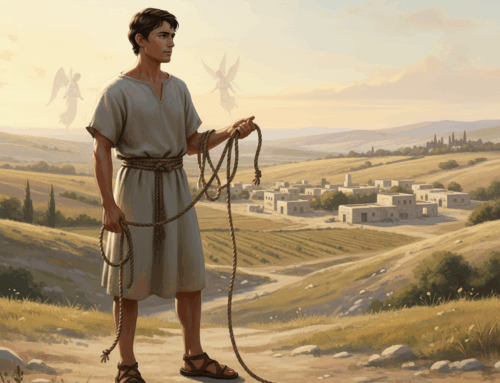
Put yourself in John’s sandals for a moment. As the prophets foretold, you expect not just a Year of Jubilee but an era of full and final Jubilee when all the wrongs would be righted, and all the prisoners set free (Isaiah 61:1). Yet here you are, the most righteous of righteous men, imprisoned for months in the fortress of a scoundrel, the least righteous of unrighteous men.
And while you sit rotting in a desert prison, out there Jesus is befriending lawbreakers. He is not acting like God’s Son, but like a rebellious son. He eats and drinks with sinners. It’s bad enough that Jesus isn’t wearing scratchy clothes and hasn’t taken up the bugs and honey diet. It’s even worse with whom he is eating and drinking: tax collectors, sinners, political traitors, and moral traitors.
Imagine the questions that might have run through John’s mind as he sat chained in that stinking desert oven of a dungeon. Why didn’t Jesus take the earthly power offered to him when he was tempted in the wilderness? And why did he take four fishermen into his inner circle and tell them their mission was to catch men for salvation, not judgment for rebellion? And why has he been telling people to love their enemies and pray for those who persecute us rather than smiting evil wherever he finds it? And why isn’t Jesus in Jerusalem, the holy city, the capital city? What is Messiah doing in this backwater country of Galilee? Why does he heal these people? Why be a do-gooder to the done-bad? What was he thinking healing a centurion’s slave?
Certainly, we don’t know what specific misgivings John had about Jesus as Messiah. But we do know he had misgivings or even doubts. And we know this from verses 2 and 3:
Now when John heard in prison about the deeds of the Christ, he sent word by his disciples 3 and said to him, “Are you the one who is to come, or shall we look for another?
It’s a pretty straightforward question. It shows John’s honest confusion and reservations. Like other prophets who have gone before him, like Elijah despairing of his life after the victory of Mount Carmel pursued by Jezebel (1 Kings 19:4), like Jeremiah cursing the day he was born while grieving the impending doom to come upon God’s people (Jeremiah 20:14-18), John has a moment of misery and misunderstanding that has led to honest misgivings.
With loving understanding, Jesus graciously answered John’s doubts:
Go and tell John what you hear and see: 5 the blind receive their sight and the lame walk, lepers are cleansed and the deaf hear, and the dead are raised up, and the poor have good news preached to them. 6 And blessed is the one who is not offended by me.
Jesus says in essence, “Tell him not to be upset by what I am doing. The one who is not offended by me will be blessed. John can trust me. I’m the one. I’m the right guy.” His actual answer is insider Bible-talk. Without directly quoting the Bible, Jesus relays a message that John would understand.
He invited John to “see” and “hear” what God’s Word says about the Messiah and then, based on that word, to change his expectations. If John could understand what Isaiah’s Messiah was to do, it would fit what Jesus was doing. John asked Jesus if he was “the coming one,” a likely reference to Isaiah 35:4. In that passage, Isaiah sings of God’s coming “with vengeance” to judge. Jesus answers that he is coming to judge (Jesus will end this text before us with judgment). But first he comes to save.
Listen to Isaiah 35:4-6, the passage both Jesus and John are referencing:
Say to those who have an anxious heart, “Be strong; fear not! Behold, your God will come with vengeance, with the recompense of God. He will come and save you.” 5 Then the eyes of the blind shall be opened, and the ears of the deaf unstopped; 6then shall the lame man leap like a deer, and the tongue of the mute sing for joy. [2]
Jesus is not merely asking John to consider who can raise the dead. He is not merely asking John to consider who gives sight to the blind. He is not simply saying that he is so powerful he must be Messiah. Jesus rests his authority not simply on his actions, but upon the Word of God. In Luke chapter 4, Jesus read from the scroll of Isaiah 61:1, 2:
The Spirit of the Lord God is upon me, because the Lord has anointed me to bring good news to the poor; he has sent me to bind up the brokenhearted, to proclaim liberty to the captives, and the opening of the prison to those who are bound; 2 to proclaim the year of the Lord’s favor, and the day of vengeance of our God; to comfort all who mourn. [3]
The day of God’s vengeance is coming. God’s enemies will receive their just reward. But first Christ must bring the gospel to the poor. The poor must have the good news preached to them (11:5b). That is the substance of Jesus’ answer to John.
Stop and think about this scene for a second. Two things will come to your mind. First, if it’s okay for the world’s greatest prophet (11:11) to have a period of doubt concerning Jesus, then it’s certainly okay if you or I struggle with occasional doubts. Second, if we are to doubt, perhaps because we are experiencing hardship, we should doubt as John did. John took his doubts to Messiah Jesus. John knew where to direct his waning trust. In faith, he came to Jesus for answers.
Often our doubts revolve around us not getting our way. “Why can’t I do whatever I feel it is right for me to do?” That is self-centered doubt. The focus is entirely on us. But John’s doubt centered around the person and work of Jesus. So he turned to Jesus for answers. In effect, John was saying, “Lord, I believe. Help my unbelief.”
DISBELIEF (7-24)
In verses 2-6, we have John’s doubt and Christ’s cure for that doubt. Given Jesus’ extremely positive comments about John beginning in verse 7, John most likely listened to Christ’s word. Though John would never get out of that dungeon alive, he meditated on the words of God and climbed out of the depths of his doubt.
That brings us to verses 7-24. Here, Jesus turns his attention to the crowds that have been following. John’s disciples depart and Jesus addresses the crowds (11:7). What would he have to say to them? He speaks words of judgment! John would not stay offended by Jesus, but the crowd, which we take in part to be composed of those people from the towns mentioned in verses 21-24, would stay offended.
Like spoiled children, they would accept nothing God put before them. John came through town, preached his sad song of repentance, and they said, “He’s a madman!” Christ came through town preaching his joyful message of salvation, and they said, “He’s immoral!” God sent John and they did not repent. God sent Jesus, and again they “did not repent” (11:20). They had fascination, but no faith. They had curiosity, but no contrition.
Verses 20-24 follow the pattern of Old Testament prophecies against the gentile nations in Isaiah 13-20, Jeremiah 46-51, Ezekiel 25-32, and Amos 1-2. In our text, Jesus pronounces the coming woe of judgment upon these Jewish (not gentile!) cities. Matthew’s Gospel, remember, is upside down from the way we normally think. God pronounces God’s woe upon God’s chosen people in God’s Holy Land:
21 “Woe to you, Chorazin! Woe to you, Bethsaida! For if the mighty works done in you had been done in Tyre and Sidon, they would have repented long ago in sackcloth and ashes. 22 But I tell you, it will be more bearable on the day of judgment for Tyre and Sidon than for you. 23 And you, Capernaum, will you be exalted to heaven? You will be brought down to Hades. For if the mighty works done in you had been done in Sodom, it would have remained until this day. 24 But I tell you that it will be more tolerable on the day of judgment for the land of Sodom than for you.”
If Israel’s pagan enemies, Tyre and Sidon, had seen Jesus do his Messianic works, they would have thoroughly repented. Even the worst city ever (Sodom) will get off with a slap on the hand compared to Capernaum. Those are harsh words for Jesus’ adopted hometown and home mission base. What had they done to deserve this? They were guilty of perverse normality. Like most people in the world, they were not guilty of any notorious crime or anything particularly offensive or inhumane. They had committed no abnormal atrocities. What Jesus condemns is the normal perversity of disbelief.[4]
You might wonder if disbelief really the worst sin in the world? We all rank offenses differently: murder, adultery, stealing, parking in a handicap space without a sticker, eating trans fats, offending people with our resolute beliefs. But disbelief, failure to trust in Jesus? That is nowhere on the world’s list of offenses. But it is at the very top of Christ’s list!
We struggle with disbelief being so evil because the world, the flesh, and the devil scream the opposite message. Do you believe in Jesus – that he is the only way to God, that his commandments are authoritative for all peoples everywhere, and that every knee should bow before him in worship (themes we see repeatedly in Matthew)? The world believes that to be unethical. Who are you to say what other people should think, or feel, or do? To preach this good news to others (as Jesus suggests in chapter 10) this viewed by many today as being as unethical as stealing candy from a toddler on its birthday.
The world’s strong sentiment is that disbelief is no sin at all, and further that belief in Jesus, as he is presented in the Bible, is at the top of society’s sin list. Fundamental faith in this Jesus is viewed as fundamentally wrong. Whose voice will you follow? Will you listen to the world, the flesh, the devil, the universal ethicist? Who has authority in heaven and on earth to tell you what to think and do? Is disbelief in Jesus contemptible or is it intellectual? Is it condemnable or commendable? Jesus says it’s contemptible and condemnable, and especially for those who were so close to the action.
When you haven’t seen or heard Jesus in a while, as John the Baptist hadn’t, and doubt sets in, that is one thing. Such doubt can be dealt with correctively in love. But when you have seen and heard Jesus, as the people in those three cities had, and disbelief sets in, that is a heavy matter. That is hardness of the heart that cannot readily be softened. It is better to tie the whole bundle up and throw them into the bottom of the sea.
Jesus judges the disbelief of the people in these three cities so strongly because they saw the mighty works of God more than any other people, and yet they did not repent and believe. Notice the phrase used in verses 21 and 23: “If the mighty works done in you had been done…” in Tokyo, Cairo, London, or Las Vegas, even people from those large secular cities would have believed. Jesus denounced the places where most of his mighty works had been done, because they did not repent and believe (11:20).
We could think today of a person who grows up in a country where Christianity is prominent, or at least normative (like our country). They had been surrounded by the gospel taught and lived out at church and home by Christians. Yet they reject the saving grace of God. Maybe that describes you. Be warned. It is no trivial matter to know so much and not believe.
Why is Jesus so upset at these people? First, the powerful miracles should have produced faith. Second, the person of John should have produced faith. Look at versus 7-15, and we’ll find our explanation. Starting in verse 7 Jesus gives what we might call his “Sermon on John the Baptizer.” And for every point in it he makes about John, he also makes a point about himself.
What did you go out into the wilderness to see? A reed shaken by the wind? 8 What then did you go out to see? A man dressed in soft clothing? Behold, those who wear soft clothing are in kings’ houses. 9 What then did you go out to see? A prophet? Yes, I tell you, and more than a prophet. 10 This is he of whom it is written, ‘Behold, I send my messenger before your face, who will prepare your way before you’ [Malachi 3:1].
John was more than a mere prophet because he was prophesied. He is more than a bearer of prophecy. He is an object of prophecy. He is the prophet promised as the advance man for the Messiah. If that is John, Jesus in effect asks the crowd to consider who he is. Malachi 3:1 says, “Behold. I send my messenger and he will prepare the way before me.” In our text, Jesus changes the pronouns: “Behold, I send my messenger before your face who will prepare your way before you.” The second person singular pronouns do not refer to God but to Jesus. Jesus is claiming to be both the Lord God and the Messiah. Both with this earlier allusion to Isaiah 35 and now with this quotation from Malachi 3, he is making the point that his coming is the coming of God himself!
No person born on earth has ever been greater than John the Baptizer. Yet the one who is least in the Kingdom of heaven is greater (11:11). In other words, as great as John was, his ministry was old school, it was old wine and old wineskins. He was the last and greatest Old Testament prophet. But now, even the littlest newborn in the Kingdom of heaven, someone who has just come to faith in Jesus, is greater. They are not greater in stature or holiness, but truly greater because the new covenant is a “better covenant” than the old (Hebrews 7:22; 8:6). In that sense, the new believer is better off than the greatest Old Testament prophet, John.
With that idea in mind, here is what we are to know. Here is the a fortiori argument Jesus is making: If John is the greatest man ever born, and if the most insignificant person in the coming Kingdom of heaven is greater than John, what does this make Jesus who is the bringer of that Kingdom? Let’s think about that argument and learn a little more about Jesus.
In verses 7-15 we see Christ’s three-point sermon on John:
- If John is the Super-prophet, what does that make Jesus?
- If John is the greatest pre-Kingdom man, what does that make Jesus as the king of the heavenly Kingdom?
- If John is “Elijah,” not some reincarnation of the actual prophet Elijah, but the one who has come as the Jews expected in the “spirit and power” of Elijah, the one who would prepare the way for God – who is Jesus?
Based on those points, we can paraphrase verses 12-15 this way:
… from the days of John the Baptist until now the kingdom of heaven has suffered violence because violent people—like Herod and Caiaphas, the political and religious establishment—are always trying to destroy it, take it by force, and step on it [read chapter 10 again: the kingdom will be victim before it is victor]. Matthew believes that we cannot think too highly of Jesus. Jesus is talking about John. For all the prophets (like Elijah) and the Law (Moses) prophesied until John, and if you are willing to accept what I’m getting at, John is that Elijah-figure who is to come, who has come. He is the one who each Passover you set a place for hoping he’ll show up. He has shown up because I am the Lord. That empty chair has been filled, for behold the Lamb of God who takes away the sins of the world. Do you hear what I’m saying?[5]
Matthew is writing about Jesus. We readers are supposed to think about God. The point of these verses is that Jesus is not simply the Messiah sent from God, he is God in the flesh.
EXPECTATIONS
That brings us back to our question of why Jesus pronounced these severe woes upon this crowd. First, because the powerful miracles should have produced faith in him (11:20-24). Second, the person of John should have produced faith in the person of Jesus (11:7-15).
We began this morning by talking about expectations. We all have expectations when it comes to a party, a blind date, a church service, and even when it comes to God. Some might expect that if there is a God, he should write his name and message in the stars: “YHWH is my name and Jesus is my Son.” If only he would do that, people would repent and believe. But God has expectations also. He expects human beings to repent and believe because he has done something far greater than writing a message in the stars.
First, he sent his prophets (from Moses to John) to prepare the way for the Lord. Many of these prophets wrote down what we should expect God to do in history. Then, in the fullness of time, God sent his own Son to teach, perform miracles, be lifted up on the cross, rise again from the dead, and a sin to his glory in heaven (all witnessed by numerous people). And yet we ask for more. We want God to scribble signs with the stars when he is plainly given his word in scripture and his word in the flesh, his unique Son. What spoiled children we are!
What wedding jig do you want God to play before you will dance, what dirge should he sing before you will cry? The Word of God and the Son of God should be enough. That should be enough to get all of us to repent and believe, to follow the Lord Jesus Christ and trust into his perfectly-lived, law-keeping life and his sacrificial blood-shedding death.
The Spirit and the Bride say, “Come.” And let the one who hears say, “Come.” And let the one who is thirsty come; let the one who desires take the water of life without price. [6]
[1] The Holy Bible: English Standard Version (Wheaton, IL: Crossway Bibles, 2016), Mt 11:1–15.
[2] The Holy Bible: English Standard Version (Wheaton, IL: Crossway Bibles, 2016), Is 35:4–6.
[3] The Holy Bible: English Standard Version (Wheaton, IL: Crossway Bibles, 2016), Is 61:1–2.
[4] O’Donnell, Douglas Sean. Matthew: All Authority in Heaven and on Earth (Preaching the Word) (p. 296). Crossway. Kindle Edition.
[5] O’Donnell, 298. Kindle Edition.
[6] The Holy Bible: English Standard Version (Wheaton, IL: Crossway Bibles, 2016), Re 22:17.