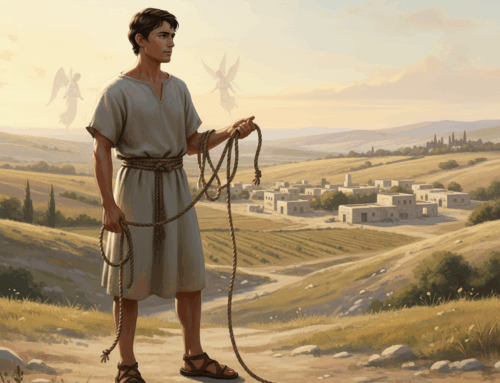

Matthew 11:25-30
25 At that time Jesus declared, “I thank you, Father, Lord of heaven and earth, that you have hidden these things from the wise and understanding and revealed them to little children; 26 yes, Father, for such was your gracious will. 27 All things have been handed over to me by my Father, and no one knows the Son except the Father, and no one knows the Father except the Son and anyone to whom the Son chooses to reveal him. 28 Come to me, all who labor and are heavy laden, and I will give you rest. 29 Take my yoke upon you, and learn from me, for I am gentle and lowly in heart, and you will find rest for your souls. 30 For my yoke is [kind], and my burden is light.” [1]
Those ruled by self-pride cannot have God as their Father. That is the first point to take away from our study of these final five verses in Matthew 11. Pride is the greatest obstacle to a saving relationship with God whom Jesus refers to five times as “Father” in our passage: “I thank you, Father” (v. 25), “yes, Father” (v. 26), “All things have been handed over to me by my Father, and no one knows the Son except the Father, and no one knows the Father . . .” (v. 27). Pride cannot be the ruling principle in your life. Pride cannot be the authority over all your actions. It cannot be the voice telling you what to do.
As we look at Jesus’ prayer of thanksgiving following the pronouncement of terrible woes on the three cities in which he had performed so many miracles, we will see that his focus is not on us (our pride or humility) but on God, the Lord of heaven and earth as his Father. Jesus reveals a God who shows his absolute sovereignty over creation and all his creatures, even and especially human beings, by hiding the gospel from some and mercifully revealing it to others, “for such was your gracious will” (11:26).
God is the focus of this prayer, particularly his sovereign justice and grace. But why does Jesus say this prayer aloud at that particular time to his disciples and the crowd following him (11:1-24). He praises his Father aloud so that his listeners, including we today, might apply such praise. And remember, we said our application right up front: you cannot be ruled by pride and have God as your Father.
There is a deep mystery here. Why does God hide the gospel from anyone, no matter how proud they are? Why doesn’t he, in his providence, humble everyone? He humbled Nebuchadnezzar, why not some of our current social media stars and politicians? I have no answer for that. God’s sovereign free will in election is a deep and unfathomable mystery. But I believe God’s Word. And I know enough of it to know what my true nature is. I know I was not so good that God should have saved me, be gracious to me, and open the eyes of my heart. According to verse 26, God would be just in damning all and saving none. So he is gracious in saving some, revealing himself, revealing his Son to those who come to him for rest, who come to him in humility.
Why some people come to trust into Christ and others don’t is a coin with two different sides. One side of the coin is God’s sovereignty, his right to exercise his free will to save whom he pleases: “I… will show mercy on whom I will show mercy” (Exodus 33: 19; Romans 9:15). The other side of the coin is human responsibility. Humility opens the door to the Kingdom, and pride keeps it closed. And in verses 23, 25 the door-slamming sin of pride gets Jesus’ attention.
Back in verse 23, where Jesus denounced the people of Capernaum for their disbelief, he echoes Isaiah 14:13-15 (the prophecy against the king of Babylon), saying, “And you, Capernaum, will you be exalted to heaven? You will be brought down to Hades.” This city that witnessed more of Christ’s miracles than any other city did not humble itself and accept Christ and his Kingdom, but they loved the dog-and-pony show. Jesus was quite a boon for their hometown, bringing in travelers and adding to their local economy.
But after he came through town and did all that he did, they refused to believe him. We can imagine them changing the city sign from “Capernaum: Fishing Capital of the Northeast” to “Capernaum: The City Lifted to Heaven. Home of Jesus the Wonder Worker.” You cannot stubbornly hold on to your self-pride and have God as your Father.
In our text this morning, in verse 25, Jesus speaks of “the wise and understanding” compared to “little children.” Those self-satisfied in their own knowledge have the gospel hidden from them, while it is revealed to little children. This is not a contrast against the smart and the dumb or the adults and the kids, but between those who are self-sufficient and consider themselves wise and those who are dependent and bring absolutely nothing to the table. Children are not profit centers, they are cost centers. When they’re very young they add nothing to support the family. They take and need everything.
It is the contrast in the Gospels between the religious aristocracy and the 12 ordinary men, between the Bible-savvy scribes and the seemingly gullible fishermen. It is the difference between the Pharisee who lifts his eyes to heaven and thanks God that he is not like all the little people around him and the tax collector who pounds his chest and begs for mercy in his complete unworthiness (Luke 18:10-14). It is the difference between the smug dismissiveness of Caiaphas and the Roman centurion who points to Christ crucified and says, “Truly this was the son of God!” (27:54). It’s the difference between the rich young ruler who walked away sad, with his camel-sized pockets still full of gold, and little Zacchaeus, who climbed up a big Sycamore tree and came down with an open heart and an open pocketbook for the poor. It is the difference between conceited self-reliance and meek dependence upon God through Christ.
So if you find yourself considering the person of Christ, thinking you’re willing to admit that at least he must be quite the guy, turn the lens you have on him back on yourself and ask if you are little enough in your own eyes to see him for who he is. God is not looking for big shots. He is not interested in the somebodies of this world. He is interested in the last, the lost, the least, the little, and the dead. Are you enough of a nobody for him to be interested in you? Before him do you humbly confess your unworthiness, emptiness, and helplessness? Do you acknowledge that you’re not good enough for God? Or has your education, wealth, power, position, talent, or knowledge puffed you up (1 Corinthians 8:1)?
“God opposes the proud but gives grace to the humble” (Proverbs 3:34 LXX; James 4:6; 1 Peter 5:5). “There are six things that the LORD hates, seven that are an abomination to him . . . [number one!] haughty eyes” (Proverbs 6:16, 17). “Whoever exalts himself will be humbled, and whoever humbles himself will be exalted” (23:12). Do you want to become a son or daughter of the heavenly Father? You must become childlike in faith, trust, and dependence (cf. 18:3). You must become like a newborn; you must become, as it were, born again.
NO SON, NO FATHER
The persistently, unrepentantly proud cannot have God as their heavenly father. That’s the first point of the passage. The second is this: the person who knows not the Son knows not God. Jesus makes this point in verse 27:
All things have been handed over to me by my Father, and no one knows the Son except the Father, and no one knows the Father except the Son and anyone to whom the Son chooses to reveal him.
In verses 25, 26 Jesus says that the only way into the Kingdom is through humility, and in verse 27 he gives perhaps the four most seemingly-arrogant claims in the history of humanity! He claims four things:
- He has all authority over everything. He has authority over all power and all wisdom and all authority in heaven on earth (28:18).
- He alone, as God’s unique Son, really knows God as his Father.
- We cannot know God except through the Son.
- We cannot know God unless he chooses to reveal himself to us.
Those are very lofty claims made here by the one who calls himself “lowly in heart” (11:29). Aren’t these claims very offensive in our day? In one verse Jesus managed to offend the entire world. He claimed to have all authority and that he come from God, and like God, has lordship over heaven and earth (11:25). That’s a bit over the top, isn’t it? Claim to be a carpenter but not the Creator, a wise teacher but not wisdom embodied, lowly of heart but not equal with the Father. That was simply outrageously offensive to most Jews and gentiles alike. It still is.
Consider Christ’s claim that he is the Son of God. Such a statement is blasphemous to Muslims. It is considered irrelevant to Buddhists and atheists because the very existence of God is unnecessary for moral behavior and meaning of life. Next is his claim that knowledge of God comes only through knowledge of him. That idea attacks the belief systems of Hinduism and many other religions and leaves the postmodernist speechless for it undermines the agnostic notion that we cannot truly know God. How offensive!
Then he even claims that we cannot know God unless Jesus chooses to reveal him to us. That is a fatal blow to the heart of the self-governing human. Don’t I determine my own destiny? It’s all my life and my hands. Don’t I freely will all that I do? How utterly offensive to suggest that I cannot choose Christ on my own. I can do absolutely anything on my own! I am the master of my fate and the captain of my soul.
All of Jesus’ claims are offensive and arrogant unless they are true! What has convinced millions of people from different countries and cultures and centuries that these claims are true? Christ’s claims do not dangle in midair as mere lofty language, they are accompanied by his character. Jesus says he is humble, and I believe him because I’ve watched him in this Gospel.
We have watched his humble birth. We watched his temptation. We have watched him reach out to the lowly, preach good news to the poor, heal the suffering, welcome the outcast, and have compassion on sinners. And we will watch him walk the road to Calvary. We will see the crown of thorns on his brow, the whip on his back, the nails through his skin, the cries of agony, and his head drop in death. His character fits his claims. People can be very sincere about their beliefs, but God was just as sincere when he sent his one and only Son to live and teach and heal and suffer and die. In return, many mock, assuming they can believe whatever they want to think about God.
Martin Luther had some wise advice for his divinity students in his lectures on Galatians. He told them to stop speculating about the Godhead and attempting to climb into heaven to see who or what or how God is. He counseled them to hold on to this man Jesus, he is the only God we’ve got! He alone mediates the Father. In him, we have “the knowledge of the glory of God” (2 Corinthians 4:6; John 1:18; 14:9). He who knows not the Son knows not God.
REST
The third point is: he who has the Son has rest. Matthew 11:21-24 records Jesus’ denunciation, verses 28-30 his invitation:
28 “Come here to me, all you who are toiling and heavily loaded, and I will give you rest. 29 Take my yoke on your shoulders and learn from me, because7 I am meek and lowly in heart; so you will find rest for your souls. 30 For my yoke is kind and my burden is light.”[2]
Before we examine the third point, two details leap off the page from the world’s most famous invitation. First, the fact that Jesus chooses us does not vacate our choice. Right after Jesus says, “no one knows the father except the son and anyone to whom the son chooses to reveal him,” we find two commands: “Come to me… Take my yoke.” Which is it? Do we come? Does he choose us? Yes. He chooses, and we come.
Technically, that is not a paradox. The better word is antimony, the appearance of a contradiction. It is an apparent contradiction between two apparent truths. Originally, physicists believed that light consisted of waves, but Isaac Newton discovered that it consisted of particles. Only later did scientists discover that light consists of both waves and particles. How could it be both? In our tiny and tidy little minds, we don’t know. It just is. We can’t comprehend how light can be both waves and particles. It is incomprehensible, but so far, undeniable.
Salvation is an antimony. He chooses. We come. You can try to deny all the facts by claiming you chose Christ, you came to him in faith first. But to do so is as immature as a new student of physics denying the dual properties of light. You could say Jesus has thrown a lasso around us, and we are running towards its pull. God exercised his free will to choose us. He pulls us along. But we also ran toward him, happily and gratefully.
So the first detail is that God draws us according to his free-will choice and we willingly and joyfully respond to him. The second is that Jesus does not invite us to come to God. Instead he replaces “God” with the word “me.” “Come to me…” Jesus announces that not only is he Messiah (God’s Coming One), but that he is God! He is the subject of all of the Old Testament invitations for God’s sinful people to come and repent and receive God’s rest.
Remember, for Matthew you cannot think too highly of Christ. All things have been handed over to Jesus, even salvation! All of the types and shadows that represented God to his people in the Old Testament find their fulfillment in God the Son. And just wait until our passage next week! Jesus is not going to stop bombarding us with his divine identity.
Having looked at those two details that jump off the page, we come to the point at hand: he who has the Son has rest. Every person longs for rest. We all long to rest in peace not only after we die but also while we are alive. Who doesn’t want the inward and outward peace that comes from being in a peaceful relationship? Have you ever been in a wrong relationship? It is the least restful state of being. It churns you up emotionally and physically. It is exhausting and excruciating. But a right relationship brings rest, shalom.
Jesus claims that the ultimate rest, the longing of every human heart for the most right of all relationships, comes only through being in a relationship with him. That is quite a claim. Not only does he replace his name for God’s, but he claims to be the Rest-Maker, the One you must embrace to find shalom. Notice whom he invites and to what he invites them. He does not invite those who have found their self-worth. He does not invite the self-satisfied. He does not invite this self-righteous. He does not invite those living the life of ease, stretched out on the beach comfortably soaking up some sun. Jesus invites “all who labor and are heavy laden” (11:28). He invites the exhausted, the poor, the storm-tossed, the wretched refuse, the huddled masses yearning to be free.
Out of this crowd whom he has just judged for their disbelief, he still invites the last, the lost, the least, the little, and the dead to come and find their rest and peace in him. He is speaking to those who know they are “poor in spirit” (5:2). To those, he promises rest. Not at some new vacation destination, not by offering a new recliner, a relaxing massage, or a sleeping pill. No. Jesus issues a new work order: “take my yoke upon you” (11:29).
Now here’s a question: do you know what a yoke is? It is an instrument for work. But Jesus is not referring to the kind of yoke that goes around the neck of two oxen pulling a cart. Jesus is not offering to come alongside you so that you can be “double-yoked with Jesus” or “harnessed together with Jesus.” The yoke to which Jesus refers is a wooden frame placed upon your shoulders in order to make a load or burden easier to carry. It distributes the weight in equal proportions to both sides of the body. Do you see the antimony here? Seriously, what yoke is comfortable, what burden is light?
Jesus doesn’t promise escape from reality, but he promises the right equipment to deal with it. He promises a yoke. More work! But what is his yoke? This yoke must have something to do with his teachings, because he adds “and learn from me” (11:29). It is not the heavy yoke of the scribes and Pharisees. It is not the heavy burdens that the rulers of Israel have laid upon the people’s shoulders (23:4). Biblical work has a lightness to it because it has been graciously given by God as a gift to help us. It is offered from the mouth of a man who is indeed, in every way, “gentle and lowly in heart,” one who has carried God’s burdens himself (5:17).
Certainly, compared with the hundreds of Jewish laws, there are fewer commands from Christ to carry. But there is something to carry. We cannot remove from our backs the Sermon on the Mount, the parables, and the Great Commission. And yet, those teachings – understood in light of Jesus’ person and work – bring rest. Rest comes from working. Rest comes from laboring. Rest comes from obedience. Rest comes in seeking first the Kingdom of God and his righteousness. Rest comes from God’s will being done on earth as it is in heaven.
Jesus doesn’t invite us to take his easy chair or to take his mattress. He promises us a yoke. We will be working, walking, and moving forward, carrying what he tells us to carry, even our own cross. Life might be uncomfortable, hard, and trying, yet in the midst of it he promises rest, the refreshment that comes with forgiveness, the renewal that comes with purposeful living, the rest that comes from working for him, shalom that passes understanding.
That from which Jesus promises rest is the overbearing and unwinnable demands of God’s perfect Law (COW, Covenant of Works) and all of the human regulations heaped upon it. The Law constantly screams like a drill sergeant: “Do this and live. Fail and die.” But it cannot empower what it commands. It cannot release any human heart from its congenital defect of bondage to sin. The Law commands perfection but cannot produce it. That is the constant and overbearing burden of the human heart, to work to impress a holy, righteous, perfect God who can NEVER be impressed with our sin and our attempts to be relatively “good” because he demands total perfection!
I believe this invitation in our text represents the culmination of Jesus’ earthly ministry up to this point. In the Sermon on the Mount he revealed what a deep and complete perfection the Law demands from the human heart, not merely human hands. He has just finished judging a crowd because of their mere curiosity rather than contrition. Yet here he calls out to that same crowd and invites them to come and find rest. And those who have been given ears to hear, who have been chosen by an eternal act of God’s free will, are invited to come and find rest, to find God’s approval rather than his displeasure, to experience his Shalom. And they will do so. They will willingly follow the tug of the rope.
And they come to find that God’s holy Law has not been dumbed down to let them squeak by its perfect demands. Rather, they come to find the One who can and does keep God’s Law with complete perfection on their behalf. They find the True Lamb of God who will suffer for them in his blood-shedding death to pay the wages of their sin (COG, Covenant of Grace). They come to find the one who will rise from the grave as their justification and who will ascend to heaven and sit at the right hand of the Father to rule, to ordain, to sustain, and to judge all things in their time. That is why his yoke is kind and his burden is light.
The apostle Paul fleshes out Jesus’ great offer here in our text when he writes to the congregations of Rome:
3 For God has done what the law, weakened by the flesh, could not do. By sending his own Son in the likeness of sinful flesh and for sin, he condemned sin in the flesh, 4 in order that the righteous requirement of the law might be fulfilled in us, who walk not according to the flesh but according to the Spirit. 5 For those who live according to the flesh set their minds on the things of the flesh, but those who live according to the Spirit set their minds on the things of the Spirit. 6 For to set the mind on the flesh is death, but to set the mind on the Spirit is life and peace. 7 For the mind that is set on the flesh is hostile to God, for it does not submit to God’s law; indeed, it cannot. 8 Those, who are in the flesh, cannot please God.
9 You, however, are not in the flesh but in the Spirit, if in fact the Spirit of God dwells in you. Anyone who does not have the Spirit of Christ does not belong to him. 10 But if Christ is in you, although the body is dead because of sin, the Spirit is life because of righteousness. 11 If the Spirit of him who raised Jesus from the dead dwells in you, he who raised Christ Jesus from the dead will also give life to your mortal bodies through his Spirit who dwells in you. [3]
[1] The Holy Bible: English Standard Version (Wheaton, IL: Crossway Bibles, 2016), Mt 11:25–30.
[2] R. T. France, The Gospel of Matthew, The New International Commentary on the New Testament (Grand Rapids, MI: Wm. B. Eerdmans Publication Co., 2007), 440.
[3] The Holy Bible: English Standard Version (Wheaton, IL: Crossway Bibles, 2016), Ro 8:3–11.